Building Mobility for All: North Carolina’s Statewide Approach to On-Demand Transit
20 minutes Date Launched/Enacted: Nov 25, 2025 Date Published: November 25, 2025
Introduction
North Carolina has long faced structural mobility challenges stemming from car-dependent transportation planning, resulting in inadequate public transportation coverage in many non-urban areas. These mobility challenges have compounded to create persistent barriers in transportation access for vulnerable populations, including older adults, people with disabilities, and low-income populations. According to the U.S. Census Bureau, roughly 40% of North Carolina’s population resides in rural areas, which is nearly double the national average, making efficient and reliable mobility options across the state critical.
Further, one in five North Carolina residents is projected to be over the age of 65 by 2042. Aging in place requires reliable transportation that supports independence and flexibility. However, many of the state’s rural and suburban areas lack consistent fixed-route public transportation services, ultimately limiting older adults’ access to essential services like healthcare, employment, and social engagement.
In response to these challenges, the North Carolina Department of Transportation (NCDOT) launched the Mobility for Everyone, Everywhere in North Carolina (MEE-NC) program in late 2022 through NCDOT’s Integrated Mobility Division (IMD). With support from a $10.4 million Strengthening Mobility and Revolutionizing Transportation (SMART) grant from the US Department of Transportation, the MEE-NC initiative aims to build a better future for mobility by expanding on-demand microtransit in rural and suburban transit agencies and communities throughout North Carolina.
This case study was developed as part of the Mobility Innovation Collaborative (MIC) program. The MIC provides a comprehensive suite of technical assistance resources, promotes knowledge sharing activities, and captures stories and lessons learned from innovative mobility projects across the United States.
Originally published November 2025.
Building the Framework for Statewide Mobility Innovation
The MEE-NC program is operated through NCDOT’s Integrated Mobility Division, an office established in 2019 to create and align accessible and safe transportation infrastructure and goals. IMD serves as the backbone of MEE-NC, not only administering the program but also embedding it within a broader vision of statewide multimodal connectivity. Before the creation of the division, different mobility options were siloed, without any central coordinating body. For instance, bicycle and pedestrian concerns were handled separately from public transit, while other emerging mobility solutions lacked integration and strategic oversight. This siloing limited integration in multimodal systems across the state. Today, IMD combines these efforts to oversee and coordinate all active and emerging mobility programs, including MEE-NC.
IMD was designed to manage grant-making and service deployment while also serving as a central hub for statewide mobility and mobility strategy. This includes guiding local and state mobility strategies and ensuring consistency with long-term goals such as emissions standards and access to service. By overseeing MEE-NC’s implementation, IMD is ensuring that lessons learned from local pilots inform scalable, statewide practices. Since its creation, IMD has shifted how transit is planned and delivered throughout the state, moving from stand-alone systems to a multimodal, integrated, and adaptive approach that supports users’ mobility needs. MEE-NC’s structure reflects this shift through its cost support and technical assistance for transportation agencies, enabling them to scale up on-demand transportation. Using lessons from early adopters in the state like Wilson RIDE, IMD developed a comprehensive On-Demand Microtransit Guide in 2023 to help all communities (beyond just MEE-NC grantees) understand the fundamentals of service design, contracting, performance tracking, and implementing an on-demand service.
A Statewide Effort: Microtransit
As IMD took on a broader strategic role, it also began cultivating the conditions for long-term service innovation—not just implementation. MEE-NC is designed not only to fund service delivery, but also to build long-term capacity for innovation. A key component of this strategy is ensuring that communities understand their own capacity for operating transportation services. To support this, IMD administers microtransit feasibility study funding through a competitive grant program that allows communities interested in improving their transportation systems to determine if an on-demand service will meet the needs of their community, and if they have the capacity and financial means for the design and build process (design and engineering, permitting, construction, etc).
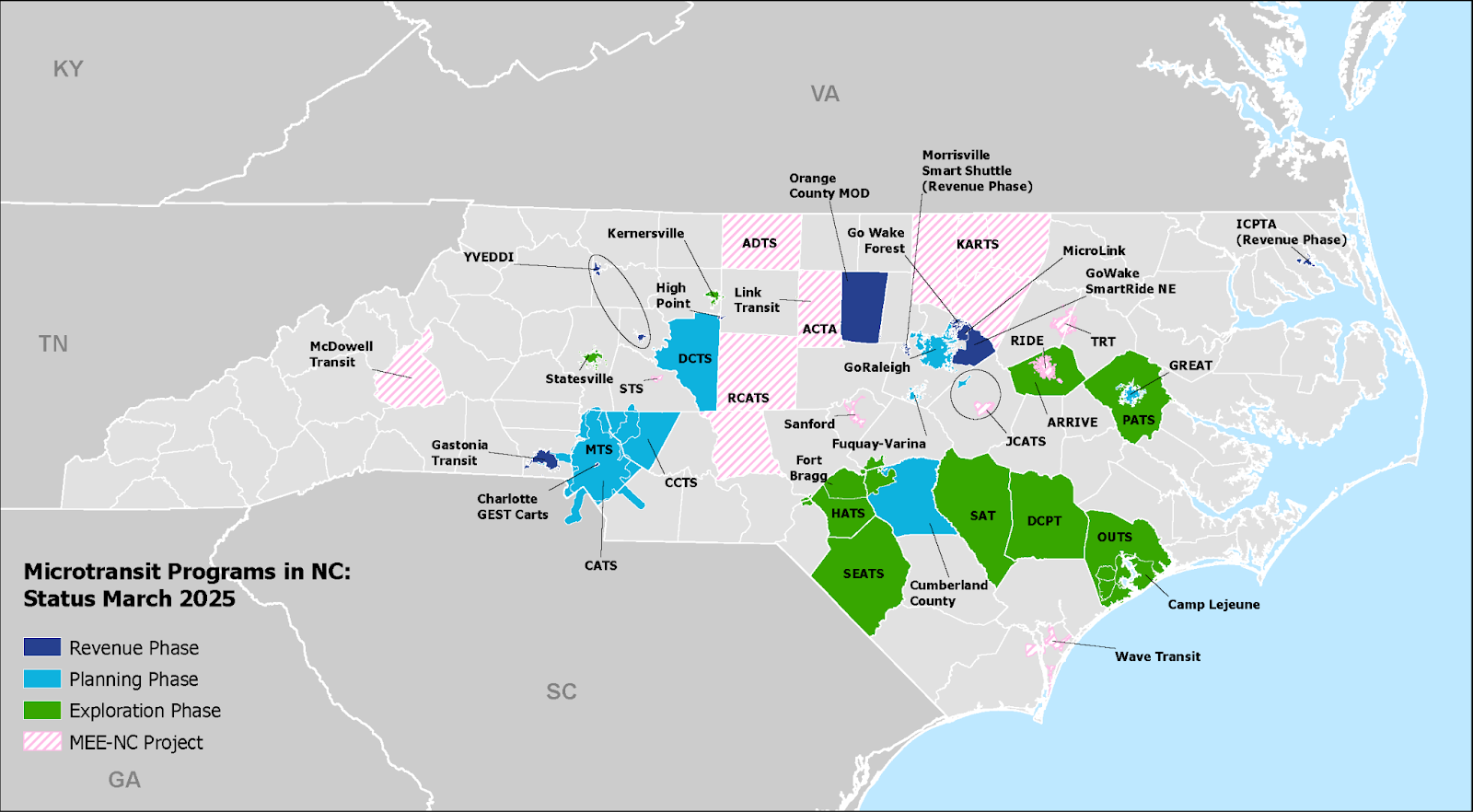
Map of microtransit programs and their status in North Carolina. Credit: NCDOT IMD On-Demand Microtransit Guide
Beyond supporting individual communities, the feasibility program also enables the state to standardize planning approaches across diverse geographies. While each community’s microtransit program is tailored to its specific needs, grantees are encouraged to follow the steps outlined in IMD’s On-Demand Microtransit Guide. This framework aligns project development with broader goals such as access, cost-efficiency, and quality of service, and incorporates metrics like wait time, fare cost, and vehicle quality. IMD tracks outcomes from each feasibility study, using these findings to refine its statewide strategy and strengthen implementation practices. This standardization helps streamline the implementation of service by directly connecting communities to state and federal funding streams. Out of the eleven MEE-NC grantees, eight of the communities also completed the feasibility study, with two going further to receive funding through FTA’s Integrated Mobility Innovation (IMI) demonstration program. The IMI grants allow transit agencies to leverage and integrate new mobility initiatives with existing services to explore new business approaches or technology solutions that support mobility. In 2020, 25 transit programs were selected for the IMI grant, including Wake County’s on-demand initiative.
For those communities that demonstrate capacity, IMD assists in every step leading up to implementation, including ideation, planning, and funding. When services are launched, IMD continues to monitor performance through annual reporting across all systems, helping NCDOT evaluate outcomes and adjust implementation strategies. For instance, IMD is helping define vehicle and service standards that help with cost efficiency and accessibility; piloting agencies are encouraged to consider vehicle size and type based on expected demand and use. Similarly, shared benchmarks such as average wait time, fare affordability, and ease of booking help foster a replicable model for microtransit service delivery across North Carolina.
The feasibility grants are not intended to be isolated planning exercises, but instead aim to help communities build momentum to implement their service, particularly for those interested in applying to MEE-NC. Several on-demand pilots in MEE-NC’s program began as feasibility studies, which helped determine service zones and partnerships, and organize themselves administratively (determine long-term funding, staff, vehicle fleet, etc). In this way, IMD creates a space for communities to work from ideation to planning to implementation while supplying necessary support and technical assistance along the way. This phased support structure ensures that microtransit initiatives are not isolated efforts, but instead part of a broader, integrated strategy for sustainable transportation access. In 2025 alone, there were: eleven regions in the microtransit first phase: the exploration phase (early ideation and scoping), six regions in the second phase: the planning phase (service design, partnerships, and funding preparation), and four regions in the third phase: the revenue phase (active service design and operations) of the feasibility study.
Mobility for Everyone, Everywhere in North Carolina (MEE-NC)
Building upon the groundwork established through the feasibility program, MEE-NC is committed to building a more responsive and accessible transportation system, especially in communities that have historically been underserved or difficult to serve adequately with fixed-route transportation. NCDOT’s IMD created MEE-NC to envision and create a future where public transportation is aligned with local needs, regardless of the community’s size or landscape. The program’s guiding principle is that mobility should be a right, not a privilege, no matter where the passenger lives.
MEE-NC is implemented through a phased approach that utilizes local insight while maintaining a cohesive statewide vision for mobility; phases include service planning, technology procurement, capital, branding, and service deployment. The initiative has funded and supported on-demand microtransit services in eleven pilot communities to date, using both turnkey (transportation-as-a-service) and Software-as-a-Service (SaaS) models, depending on local need, existing assets, and capacity. Both systems are designed to be flexible and cost-effective for low-density or rural regions where fixed-route transit may be more difficult to sustain than in higher-density areas. This approach has already shown promise in cases where flexible, on-demand services have replaced infrequent fixed-route service or have been implemented from scratch. This intentional pairing of local design with a standardized process has enabled MEE-NC to grow strategically, with lessons from each pilot reinforcing the overall program architecture. The eleven participating communities are:
- Alamance County Transportation Authority
- City of Sanford
- City of Wilson
- Kerr Area Regional Transit
- McDowell County Transportation
- Johnston County Area Transit
- Randolph County
- Rockingham
- Salisbury Transit System
- Tar River Transit
- Wave Transit
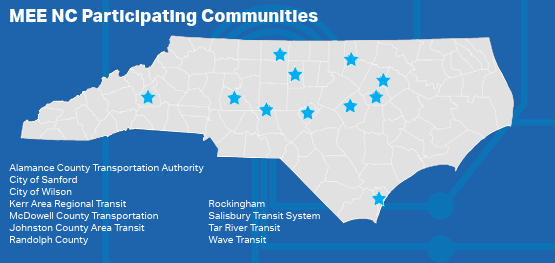
MEE-NC Participating Communities. Credit: NCDOT On-Demand Microtransit Annual Report (2023)
The foundation laid by these pilots has created an important feedback loop between local implementation and statewide learning: NCDOT has documented early results of the eleven MEE-NC pilots through the IMD On-Demand Microtransit Annual Report and Multimodal Updates slide deck, both of which use results to continue to refine MEE-NC’s vision and identify best practices for future on-demand services across the state. Based on performance data and community feedback, the results outlined in these resources offer guidance on service design, booking technologies, vehicle type, and rider experience benchmarks.
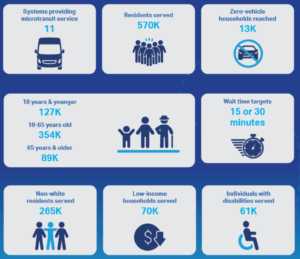
Outcomes from active NC microtransit services as of July 2025. Credit: NCDOT’s IMD Multimodal Updates
IMD manages MEE-NC and ensures that pilots aren’t isolated in their efforts, but part of the larger strategy for transforming public transportation across the state. The data highlighted in these resources displays the importance of locally tailored models, which adhere to statewide goals and standards (average wait times, shared-ride percentages, trip costs, etc). This statewide framework helps launch and manage new mobility programs and innovative technology, laying the foundation for a connected mobility network.
Importantly, these early findings not only validate MEE-NC’s phased approach but also help shape how future pilots are selected, evaluated, and scaled statewide. To understand how local pilots have influenced the design and structure of MEE-NC, three case studies—Wilson, Wake County, and Rockingham County—illustrate how key lessons and performance benchmarks directly informed the broader initiative.
Local Implementation Examples
Wilson’s Microtransit Program: RIDE
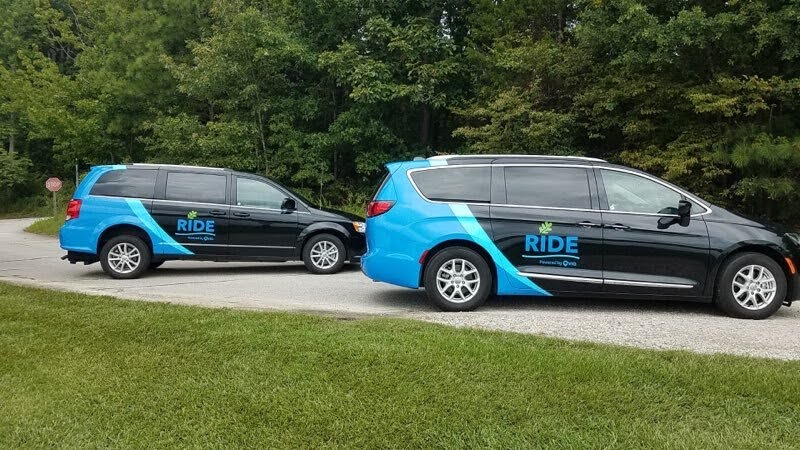
Even before the formal creation of MEE-NC, the City of Wilson, NC, had decided to transition from fixed-route transit to an on-demand program. In late 2020, the new on-demand service, Wilson RIDE, catalyzed what was to come in North Carolina’s mobility landscape. Before RIDE, Wilson’s fixed-route service only reached about 40% of the city’s population of 48,000, and delivered around 1,450 rides per week. Within just three months of switching to on-demand service, nearly 25,000 trips were completed, and the average wait time dropped from 45 minutes to around 13 minutes. The decreased wait times can be attributed to RIDE’s partnership with service provider Via, which was responsible for the upgraded technology and user interface, helping RIDE more efficiently pair riders with vehicles. In addition, this upgrade allowed passengers to request a ride through a smartphone app or web portal, in addition to the classic mode of booking on-demand service over the phone.
Wilson’s pilot validated microtransit as not just a feasible option for their community, but a better and more reliable option for communities of a similar size and context. Its success informed IMD’s early thinking about how on-demand service could be offered statewide. The key performance measures of Wilson’s RIDE service were folded into MEE-NC (wait times, coverage, and ridership growth). Moreover, Wilson achieved a 38% reduction in the cost per trip, ultimately selling on-demand services to communities that struggle to maintain fixed-route service.
Data from Wilson’s pilot showed that over half of RIDE users booked rides through the mobile app, with phone booking dropping precipitously. Notably, many passengers increasingly booked their rides using the smartphone app, and rides booked over the phone dropped from roughly 28% to 9%. This shift signaled a preference for booking options and highlighted the need for a variety of ways to book to accommodate all RIDE passengers. Insights from this data drove MEE-NC to consider passengers’ barriers to using microtransit, including a requirement for agencies to maintain a variety of booking options (app, web, and phone), fare prices, and vehicle types, especially as many of the communities enrolled have a large population of aging adults who face digital literacy or mobility exclusions. RIDE’s success became an operational cornerstone and planning blueprint for MEE-NC. Table 1 highlights how lessons from Wilson’s pilot translate into strategic decisions for the MEE-NC pilot.
Table 1
| Insight from Wilson RIDE | MEE-NC Integration |
|---|---|
| Real-time and on-demand routing with broad coverage. This gives passengers confidence in the system by ensuring that their ride will have a timely arrival. | MEE-NC sites were selected to deploy full-zone microtransit, not fixed routes. |
| Offering technology-supported booking but not limiting it to digital means (i.e., mobile app, web, and phone). Wilson ensured that passengers were able to book a ride regardless of technological capabilities or preferences. | Each MEE-NC launch guaranteed multiple ways to book, with many opting to launch a mobile booking app, while also offering lower-tech options for booking (web or phone-based). |
| Multi-source funding and public-private collaboration. The City of Wilson and RIDE worked with a variety of partners, tapping into local resources where possible. | MEE-NC uses a mix of grants and utilizes statewide vendor contracting via NCDOT. |
| Widespread community outreach and communications. RIDE consistently seeks out passenger feedback to improve the program. Especially during the planning process, RIDE cast a wide net to ensure that all potential users’ needs were considered. | MEE-NC encourages grantees to plan and improve their programs using passenger feedback, especially during the exploration phase. |
Wake County’s Microtransit Program: GoWake SmartRide NE
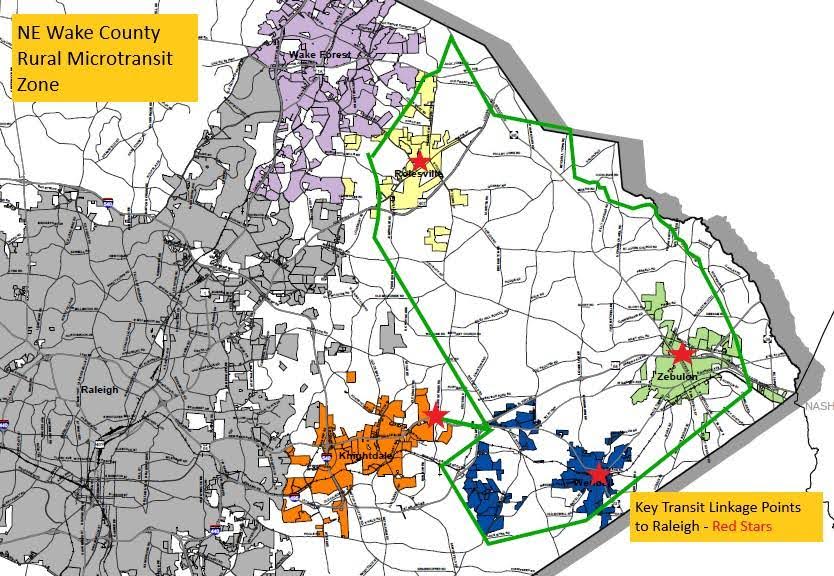
SmartRide’s service areas. Credit: Wake County Government
GoWake SmartRide NE (or just SmartRide) was initially funded in 2020 through FTA’s IMI program, and was formally launched in March 2022 by the Wake County Department of Health and Human Services. SmartRide is a zero-fare, on-demand microtransit pilot serving northeastern Wake County (specifically the towns of Rolesville, Wendell, Zebulon, and surrounding unincorporated communities). Like many on-demand programs, SmartRide aimed to connect residents to resources like education, healthcare, and employment. Notably, SmartRide connects to regional transit services that allow passengers to access larger metropolitan centers and transportation systems, including GoRaleigh and GoTriangle. The program had provided some 5,000 rides by November 2022 and surpassed 13,000 rides by the start of 2023.
While SmartRide is not formally a part of MEE-NC, the pilot implementation still offered important lessons for microtransit implementation. Wake County’s experience helped refine statewide guidance by offering an example of how microtransit can function well outside of a traditional transit agency framework. This program helped shape the statewide understanding of how on-demand transit can help improve mobility options in low-density areas. Table 2 highlights some of the insights from SmartRide that NCDOT was able to incorporate into the MEE-NC program.
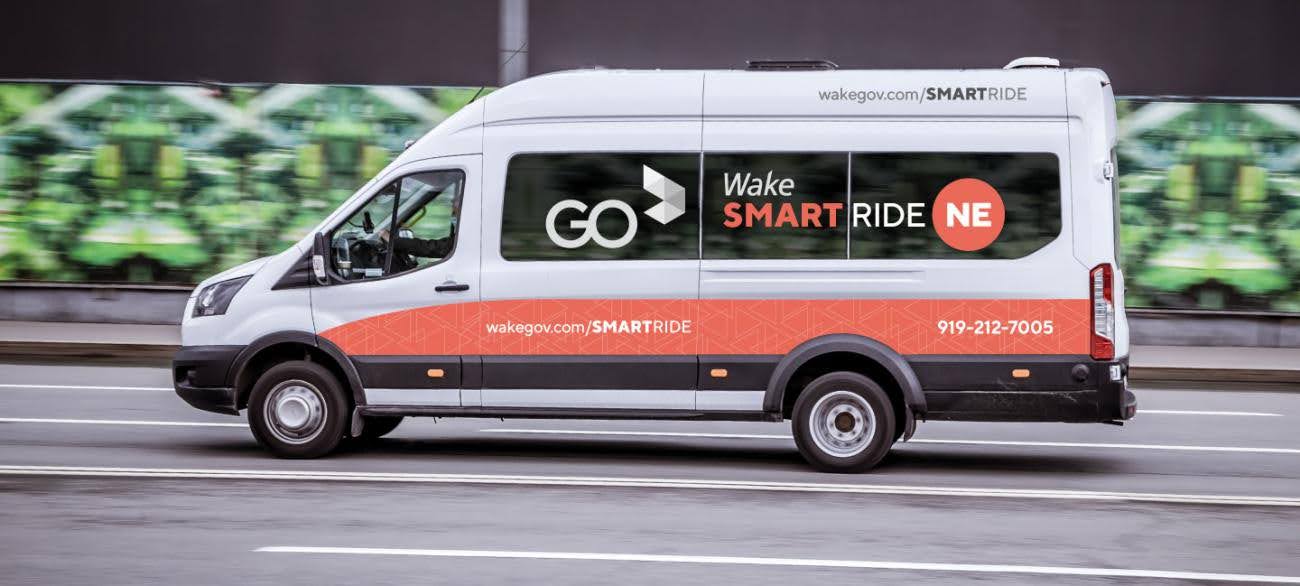
GoWake SmartRide NE vehicle. Credit: Wake County Department of Health and Human Services
Table 2
| Insights from GoWake SmartRide | MEE-NC Integration |
|---|---|
| Offering technology-supported but multi-modal booking (app, phone, and web). Like Wilson’s RIDE, GoWake ensured that passengers were able to book a ride regardless of technological capabilities. | Each MEE-NC launch guaranteed multiple ways to book, with many opting to launch a mobile booking app. |
| Long-term buy-in and transition planning ensured a sustainable business model. Long-term funding came from taxpayer dollars through the Wake County Transit Fund (a half-cent sales tax), as well as seed funding through the IMI grant. | Seeking a variety of funding ensures that long-term funding is secure, which MEE-NC encourages grantees to pursue. |
| Connections to regional transportation and metropolitan areas. GoWake demonstrated the value of connecting its residents to a larger metropolitan area, not just to destinations within its service area. | Connections to larger metropolitan areas expand opportunity for education, specialized healthcare, and more to passengers who may not otherwise have access. |
| Utilizing a non-traditional operator. GoWake SmartRide is operated by Wake County’s Health and Human Services. This non-traditional method demonstrated how departments can successfully operate a transportation system if a transit agency isn’t an option. | GoWake SmartRide acts as an example of how regions without a transit agency can still successfully implement a mobility program. |
RideSkat’s LocalLink
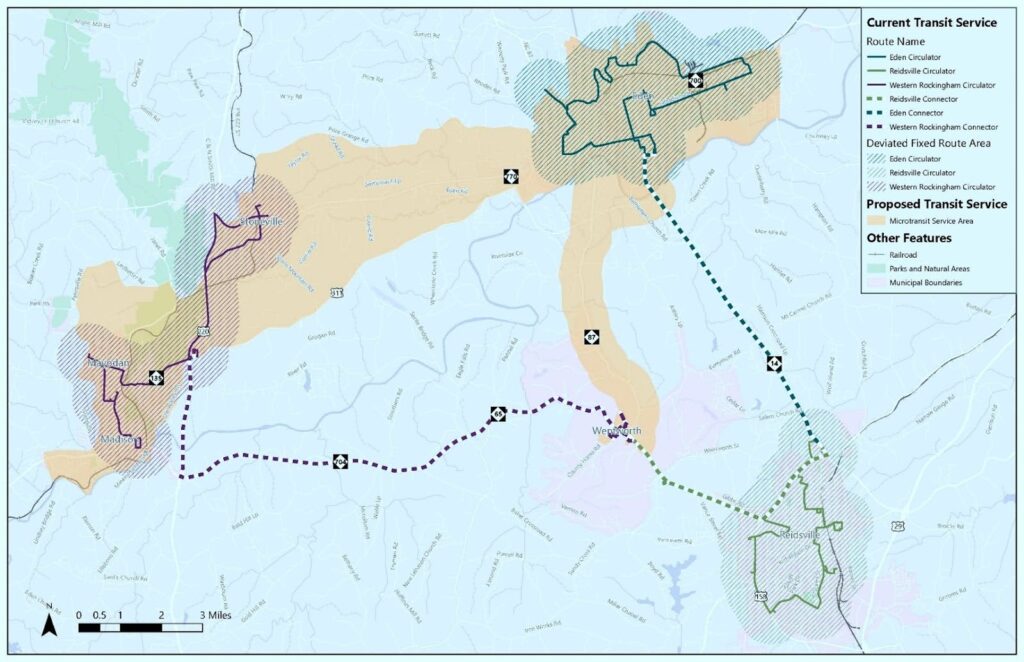
RideSkat’s LocalLink service area. Credit: RideSkat
Rockingham County Area Transit (RCATS), Rockingham County’s transportation provider, launched an on-demand microtransit service, LocalLink, to supplement the existing limited microtransit service and fixed route service. RCATS’ fixed route service, RideSkat, operates within the boundaries of multiple municipalities across the multicounty RCATS region. RCATS’ service area has faced mobility concerns with connectivity: RideSkat services don’t connect, making it difficult to travel from one municipality to another. While RCATS does operate an existing microtransit service through their Aging, Disability and Transit Services (ADTS), this service has limited trip purposes, such as Non-Emergency Medical Transportation (NEMT), and only supports residents of Rockingham County. The addition of the microtransit service, LocalLink, allowed RideSkat to bridge the gap between municipalities served by fixed route service.
Before the implementation of LocalLink, riders found themselves with few and infrequent fixed-route options, and still lacked reliable access to essential destinations like career development, groceries, and education. Because of low car ownership, long distances between destinations, and no connectivity among municipalities via fixed route services, RideSkat made a good candidate for NCDOT’s Microtransit Feasibility Grant. Through the feasibility grant program, planning efforts ensured that service would be available to all residents, vehicles were ADA compliant, and the one-way flat fee was only $5, all in an effort to reach the largest possible passenger base. In 2023, the LocalLink service launched with a curb-to-curb model in which rides can be booked over a mobile application or via a toll-free call. Similar to other microtransit services, LocalLink trips can be used by anyone and can be used for any purpose, a service that residents did not have access to previously through the RCATS NEMT service.
While LocalLink is not part of MEE-NC, it too provided scalable lessons. As one of the early projects planned and funded through the Microtransit Feasibility Grant Program, RCATS demonstrated how small agencies can deploy flexible, on-demand, and low-cost programs in low-density areas. LocalLink has provided valuable operational highlights and insights that have helped inform NCDOT’s ongoing expansion efforts for microtransit services statewide, ultimately helping guide future deployments in communities of a similar size or situation. Table 3 discusses unique insights from LocalLink that helped inform MEE-NC’s rollout.
Table 3
| Insights from LocalLink | MEE-NC Integration |
|---|---|
| Funded through NCDOT’s Microtransit Feasibility Study Grant and supported by ongoing federal and state transit funding. | MEE-NC encourages leveraging feasibility studies to guide successful rollouts. RCATS used this funding to plan service design, select vendors, and address local needs. |
| Piloted microtransit in a low-density, rural community with no existing fixed-route transit. | RCATS’ implementation showcases how on-demand transit can provide essential mobility in areas where traditional transit isn’t feasible, which is an important use case for MEE-NC’s rural strategy. |
| Operated by a rural transit provider with experience in demand-response services. | MEE-NC supports flexible partnerships and local leadership. RCATS’ approach demonstrates how rural transit systems can evolve into modern mobility providers. |
| LocalLink is designed to connect riders to essential services. Service goes beyond a typical service zone to include healthcare, employment, and education, not just local destinations. | Both LocalLink and MEE-NC initiatives are designed to bridge access gaps. MEE-NC encourages communities to include destinations that may be beyond the service area or connect to regional transit. |
Outcomes and Future Plans
Many of North Carolina’s microtransit pilots have begun to deliver measurable improvements in access, flexibility, and ridership. These metrics help reinforce the value of on-demand microtransit in small and rural communities. Early results from IMD and NCDOT from active projects show that the average wait times for these programs are consistently near 15 minutes, and early ridership growth is consistent with that seen in Wilson’s RIDE program, which reported a 58% increase in ridership over the span of a year.
The charts below illustrate some of these ridership statistics, and show the trips per revenue hour and total ridership of active microtransit services for FY2024.
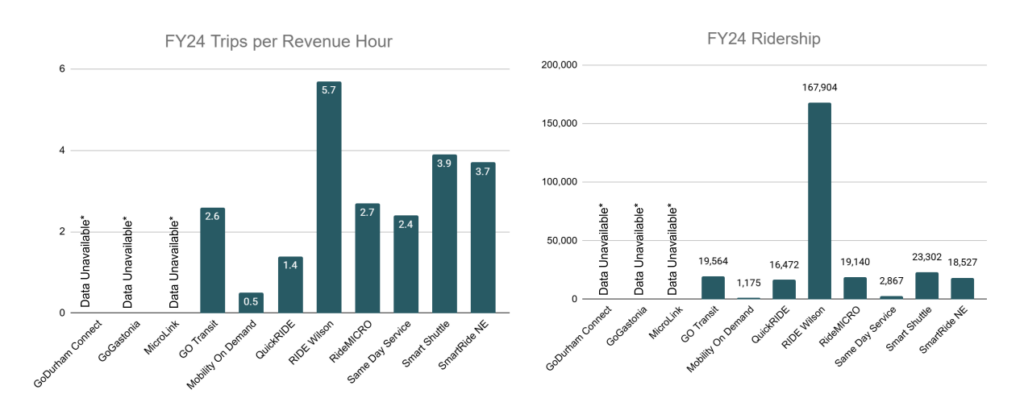
Charts showing trips per revenue hour and ridership of active NC microtransit services in FY2024. Data Credit: NCDOT
Beyond quantitative data, community feedback highlights benefits tied to service expansion, especially for older adults, low-income residents, and transit-dependent individuals who now have greater access to employment, medical care, social activities, and other essential services. For RIDE specifically, 23% of passengers surveyed cited better access to employment opportunities, 40% reported a reduction in their commute time, and 74% noted financial savings by using RIDE over another means of transportation.
To support continued learning and refinement, IMD has developed a peer learning network across pilot sites, highlighting operational insights, tips, and news that are used to inform the design process of pilot programs. Further, through MEE-NC, IMD also supports the development of shared statewide standards, such as time targets, booking tools, vehicle standards, and fare policies to ensure that replicability, efficiency, and long-term funding are consistent across programs. MEE-NC is strengthening the knowledge of local agencies in terms of funding by encouraging agencies to apply for federal funding sources such as IMI or rural transportation funds, and is working with NCDOT to expand MEE-NC beyond the original 2024-2026 window.
Lessons Learned
These early results and continued peer collaboration have revealed important lessons that now inform both state and local planning. The early deployment of Wilson’s RIDE pilot program laid a solid foundation for MEE-NC, providing a valuable test case for understanding how flexible, on-demand transportation can serve as a viable alternative to traditional fixed-route transportation in small or rural communities. As one of the first fully on-demand public transportation programs in the state, RIDE proved that rider-friendly technology and shorter wait times can improve the lives of its passengers. Just within a year of launching, Wilson experienced ridership growth that was noticed by other transportation agencies, county programs, and the state of North Carolina. RIDE’s outcomes pointed to the demand for transportation that is well-suited to its community, and acted as a model to inform statewide mobility initiatives like MEE-NC.
One of the most prevalent takeaways from MEE-NC’s pilots is the importance of strong coordination between the state and local partners. Local agencies offer knowledge of their community’s needs, trends, and mobility landscape, while the state brings funding, planning techniques, and a high-level vision of how local agencies fit into statewide goals. Working together, IMD and MEE-NC facilitate planning workshops, service design guidance, and peer learning networks that empower local agencies to gather the necessary information and resources to implement microtransit programs. Moreover, MEE-NC has demonstrated the importance of community engagement and buy-in from local partners in both feasibility and ongoing operations. The pilot programs that took an active approach to involving riders, local employers, and community-based organizations during the planning process saw higher ridership and received more local funding.
Another critical component to successful implementation through MEE-NC is the prevalence of data transparency and continuous evaluation; IMD requires all MEE-NC programs to annually report their key performance indicators, including average wait time, cost per trip, and customer demographics. This reporting process ensures that service adjustments are reflected in real time, and system knowledge is shared among new pilots and programs. Using data from the eleven pilot areas, IMD has identified common challenges and successes that are reflected in its On-Demand Microtransit Guide.
Agencies across North Carolina are implementing microtransit services to address their varied community needs and contexts, and exploring how best to match microtransit deployments and partnerships to agencies’ goals to improve their transit services. Table 4 below, adapted from NCDOT’s IMD Multimodal Updates, describes details of active microtransit services in the state as of July 2025, and demonstrates the diversity of service models, technology vendors, operations providers, and partnerships in these projects.
Table 4
| Microtransit Service | Type | Primary Purpose | Vehicle Sourcing | App Provider | Driver Hiring & Training | Managing Service Operations | Fleet Size | Advanced Booking | Funding Source |
|---|---|---|---|---|---|---|---|---|---|
| GO Transit | SaaS | Replacement | YVEDDI | CTS Software | YVEDDI | YVEDDI | 6 | Up to 30 days in advance | FTA Section 5311 funds |
| GoDurham Connect | TaaS | Serve Transit Deserts | GoDurham | Spare Labs | WeDriveU | WeDriveU | 51 vehicles (comingle) | Up to 3 days in advance | Durham County Transit Plan (Sales tax, rental tax, vehicle registration fee) |
| GoGastonia | TaaS | Replacement | Gastonia Transit | Via | Via | Via | 21 vehicles with 2 spare vehicles | Not offered | FTA section 5307 funds |
| MicroLink | SaaS | Replacement, Low Density | GoRaleigh | Via | GoRaleigh | GoRaleigh | 3 | Not offered | Wake Forest Community Funding Grant, Wake Transit Plan funds |
| Mobility on Demand | SaaS | Low Density, Convenience | OCPT | TransLoc | OCPT | OCPT | 5 | Not available | Long Range Transit Plan (local transit tax) and FTA Section 5307 funds |
| QuickRIDE | SaaS | Convenience | JCATS | CTS Software | JCATS | JCATS | 5 | Up to 7 days in advance | Rural State Operating grant and County funds |
| RIDE Wilson | TaaS | Replacement | River North Transit/Via | Via | Via | Via | 19 | Not offered | FTA Section 5311 funds, Rural State Operating grant, ARPA funds, local City of Wilson funds |
| RideMICRO | TaaS | Connection, Replacement, Low Density | Daniels Transportation | Moovit | Daniels Transportation | Wave Transit | 4 | Up to 7 days in advance | NCDOT ConCPT, local tax dollars, ticket sales |
| Same Day Service | SaaS | Convenience | ICPTA | CTS Software | ICPTA | ICPTA | 2 | Not offered | Rural State Operating grant |
| Smart Shuttle | TaaS | Provide mobility options to community members | GoCary | Via | GoCary | Town of Morrisville | 2 | Not offered | Town of Morrisville General Fund, CAMPO Community Funding Area Program |
| SmartRide NE | TaaS | Connection, Low-Density, Convenience | RATP Dev | Ecolane | RATP Dev | RATP Dev | 4 | Up to 24 hours in advance | FTA Section 5311 funds, Wake Transit, Community Funding Area Grant |
Conclusion
MEE-NC represents the desire for a shift in mobility options across the United States, especially in rural and suburban areas. In a state where car dependency is deeply entrenched and there is a growing older population, MEE-NC demonstrates that public transportation can be flexible and meet people where they are. Through the strategic planning effort of NCDOT’s IMD, MEE-NC has evolved into a statewide effort that supports the rollout of on-demand microtransit as well as a cooperative ecosystem for needs evaluation, planning, and funding to make these services sustainable over time.
Learning from early microtransit adopters like Wilson Ride, GoWake SmartRide NE, and RCAT’s LocalLink, IMD was able to scale successful models into a replicable statewide framework. These communities demonstrated that on-demand service can drastically improve outcomes for riders when it is thoughtfully planned and funded. In turn, IMD translated those lessons into core requirements for MEE-NC. For rural areas, these efforts demonstrate a shift away from siloed fixed-route transportation and a move towards flexible and on-demand service that is more scalable and responsive in areas where fixed-route is difficult to operate productively. Crucially, MEE-NC is not just a transportation initiative in North Carolina; it is an example for the US of how state and local agencies can co-create long-lasting infrastructure that is people-centered and performance-driven. The coordination between NCDOT, IMD, and MEE-NC grantees has helped bring visions to life while aiding in the exploration, implementation, and technical guidance beyond the boundaries of any single project.
As the pilot phase continues, the groundwork laid by MEE-NC is already shaping the future of rural and suburban mobility in North Carolina. The initiative is poised to grow well beyond its initial eleven pilot sites due to expanding interest, ongoing feasibility studies, and the help of peer networks. Moreover, MEE-NC is generating a body of knowledge that other states and agencies can learn from to create an open-source playbook for efficient microtransit in less-dense areas across the United States. In the long term, MEE-NC may be remembered not only for expanding access to transportation but also for changing how North Carolinians think about mobility as a public service and fundamentally reimagining the state’s transportation landscape to ensure that mobility is a right, not a privilege.