Green Raiteros and Green Cruisers: Shared Rides in Huron, CA
10 minutes Author: Shared-Use Mobility Center Date Launched/Enacted: Mar 27, 2026 Date Published: March 27, 2026
Clean Mobility Options Program
The Clean Mobility Options (CMO) program is a California Air Resources Board (CARB) statewide public pilot program that empowers under-resourced communities across California to understand better and overcome mobility obstacles with funding for Community Transportation Needs Assessments and Mobility Project Funding (MPVs) to fund clean, shared, zero-emission transportation projects. The program has awarded $66.5 million across 73 communities. Window 1 of the CMO program provided vouchers of up to $1.8 million each to 20 MPV awardees across California.
CARB selected an administrative team, including CALSTART, Shared-Use Mobility Center (SUMC), emergent labs, and Heartquist Strategies, to provide comprehensive technical assistance to these communities from application to implementation, making this critical funding more easily accessible to eligible applicants.
The Shared-Use Mobility Center is the Technical Lead for the program, leading technical assistance, evaluation, and program design. SUMC’s vision is that all people have access to joyful, dignified, equitable, safe, reliable, and affordable transportation options, even if they don’t own a car. This vision is applied to our work with awardees of CMO. SUMC’s team of cohort facilitators and researchers connect, equip, and empower awardees through the tool and resource development, program evaluation and analysis, and the Clean Mobility Equity Alliance (CMEA). Working closely with each awardee, our team supports decision-making, knowledge gathering, and operational insights, enabling planning, implementation, and sustainability.
Video featuring Liane Randolph, California Air Resources Board Chair, Huron Mayor Rey Leon, and residents Soledad Lemus and Gregorio Hernandez describing how Huron uses the CMO voucher to provide affordable rides for its community in a rural context. Credit: SUMC
A Snapshot of Huron, California
Huron, California is a predominantly Hispanic agricultural community located 50 miles outside of Fresno in the heart of California’s Central Valley. As of the 2020 Census, Huron had a population of 6,411, with a projected 6,900 residents by 2026. The farming town is considered a disadvantaged and low-income community, with a Healthy Places Index Score (HPI) of 2.6 out of 10. Residents breathe air consistently ranked as some of the country’s worst. With Huron’s average household income of $35,000, average car ownership costs can take up to 40 percent of a household’s yearly income (up to $15,614 per year), according to the Housing and Transportation Affordability Index (H+T Index). Data show that 13.1% of residents in Huron lack access to a private vehicle (U.S. Census Bureau, ACS 2023 5-year estimates, Table S2504). Chronic air pollution, coupled with this lack of access, underscores the need for sustainable mobility solutions.
In response to some of these issues, Huron has relied on an informal raiteros system, an indigenous ridesharing service provided by volunteer drivers, for decades. These types of systems are commonly found in large Latino communities. The raiteros model fills a critical niche in under-resourced rural markets across the U.S.
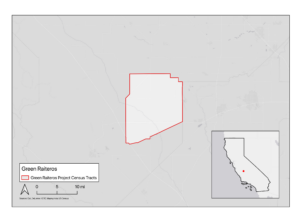
Location of Huron in the state of California. Credit: SUMC
Project Details
The Latino Equity Advocacy & Policy (LEAP) Institute, with the support of CMO funding, has pioneered a transformative initiative in the City of Huron, the expansion of the Green Raiteros rideshare program and the launch of the Green Cruisers program, a new e-bike and e-trike sharing program. This project offers residents an on-demand microtransit service and long-term rental service of e-bikes and e-trikes. These initiatives aim to provide residents with sustainable and convenient transportation options, particularly for seniors, low-income individuals, and youth.
| CMO Funders | California Air Resources Board, California Climate Investments, California Energy Commission |
| Funding | 1,800,000 |
| Awardee | The Latino Equity Advocacy & Policy (LEAP) |
| Location | City of Huron |
| Operator | Self-operated, community drivers |
| Project | Green Raiteros and Green Cruisers |
| Community Partners | Veteran Community Raiteros |
| Supporting Partners | EVgo, California Public Utilities Commission (CPUC), The Schmidt Family Foundation-11th Hour Project, The California Endowment, BioDico, Golden State Clean Energy LLC., Western Fiber, LEAP Industries, Building Trades Council, and West Hills Community College District |
| Other funding | General Motors and the California Workforce Development Board (CWDB) |
| Administrative Team | Calstart, Shared-Use Mobility Center, emergent labs, Hearquist Strategies |
Green Raiteros
Green Raiteros is a community-based concept that revolutionizes mobility for rural communities. Building a culture shift away from an individual with a car to a community with a shared fleet. This program, spearheaded by long-time environmental justice advocate and Huron Mayor Rey León builds on the existing informal network of volunteer drivers who are generally local retired farmworkers.
Green Raiteros aims to revolutionize transportation and sustainability in Huron. This program was developed through the partnership between veteran community raiteros, The LEAP Institute, EVgo, California Public Utilities Commission (CPUC), The Schmidt Family Foundation-11th Hour Project, The California Endowment, and continues to gain support from General Motors, California Air Resources Board (CARB), California Workforce Development Board (CWDB) and the California Energy Commission (CEC). Other partners are BioDico, Golden State Clean Energy LLC., Western Fiber, LEAP Industries, Building Trades Council, and West Hills Community College District.
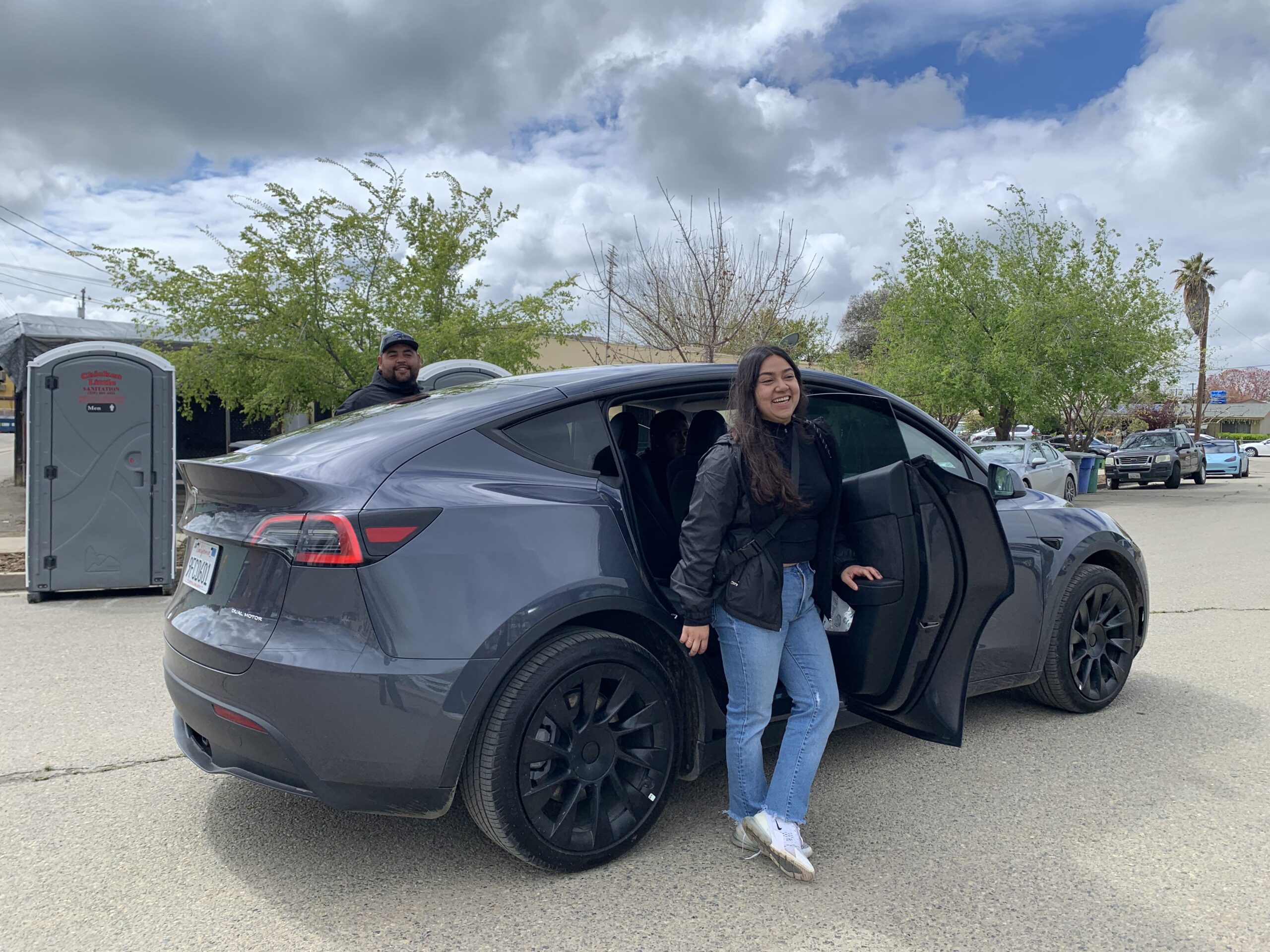
Green Raiteros provides affordable, reliable, environmentally sound transportation options to the Huron community in a more efficient manner. The service shuttles low-income residents, many of whom are elderly, and the majority of trips serve medical appointments (the trips start or end at a medical facility). The fleet comprises five Chevy Bolts, three Tesla Ys, two Volkswagen e-Golfs and a BMW i3. The average number of unique users is about 38 per year, and the average distance of a trip a raitero travels is 46.7 miles. These users are members of the community who either sign up for rides in advance or just wander into the former repair shop.
A new system within the Green Raiteros program is called “Green Riderz”. This system will help transport students from Huron and the surrounding area to universities and colleges. In collaboration with West Hills Community College, the program will also support workforce development, providing job training and creating new career opportunities for local job growth. They intend to expand the program to other universities like Fresno City College, Fresno State University, and University of California Merced.
Non-Emergency Medical Trips
Community members report spending up to $100 for medical trips to Fresno, which is over 50 miles away. Transportation to and from Huron faces additional hurdles due to unreliable transit. The cost for trips using private entities is often too high for the local community, and 72% of residents travel by car alone.
During 2024, at least 9 different major medical facilities were identified as destinations for Green Raiteros trips. The majority of medical facilities are located in Fresno and include major medical centers such as: Saint Agnes, Community Regional, United Health Centers, Kaiser Permanente, etc.
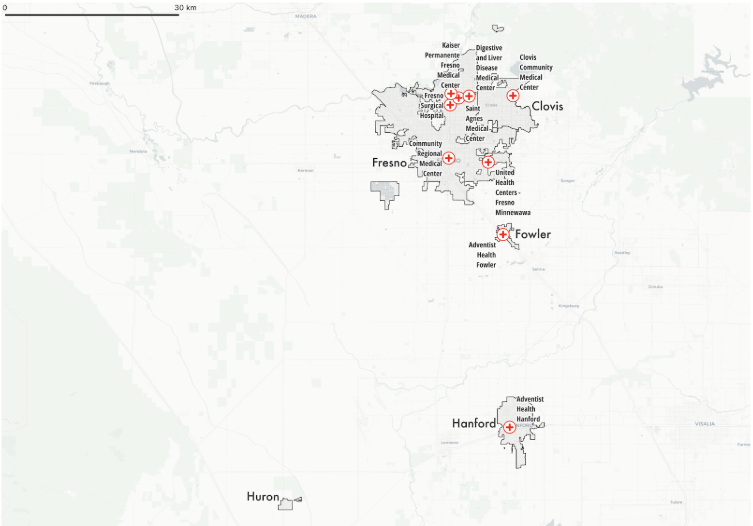
Location of medical facilities in Huron and Fresno area. Credit: SUMC
Two transit routes serve Huron directly: Coalinga and Huron Transit, which connect residents to Fresno and Coalinga. Huron residents have access to 3 daily rides to Coalinga and 1 daily service to Fresno. Given this limited service and frequency, the majority of medical facilities are effectively inaccessible using the available transit options.
As a point of reference, a trip using existing transit starting in central Huron (36509 Lassen Ave) at 8:30 AM to the different medical facilities would, on average, last four hours and require 0.5 miles of walking. The table below presents driving time estimates that serve as a reference for an equivalent trip using the Green Raiteros service.
On the other hand, the selected trips would likely take less than one hour and 30 minutes using Green Raiteros. Improved access is especially noticeable for those locations outside of Fresno or Coalinga, such as Adventist Health in Fowler. Green Raiteros allows for added flexibility through on-demand rides, compared to the available transit options that operate only a few times per day, while reducing walking distance. Currently, Huron has 3 transit stops along Lassen Avenue, the starting point of travel time estimates, meaning that residents living in other parts of Huron face longer walking distances.
| Destination | Transit Time from
Huron, CA |
Distance (m) | Routes | Fare | Green Raitero Time |
| Community Regional Medical Center | 2 hours 26 mins | 70.4 | Coalinga Transit | $4.50 | 55 mins – 1 hour 10 mins |
| Fresno Surgical Hospital | 2 hours 57 mins | 75.5 | 32; Coalinga Transit | $5.50 | 1 hour – 1 hour 15 mins |
| Saint Agnes Medical Center | 3 hours 17 mins | 77.7 | 34; Coalinga Transit | $5.50 | 1 hour – 1 hour 20 mins |
| Digestive and Liver Disease Medical Center | 3 hours 28 mins | 80.2 | 38; Coalinga Transit | $6.75 | 1 hour 5 min- 1 hour 25 mins |
| Adventist Health Hanford | 5 hours 1 min | 101.8 | 6; Coalinga Transit; Gold Runner | Not available | 30 mins – 40 mins |
| United Health Centers – Fresno Minnewawa | 3 hours 16 mins | 76.7 | 01; Coalinga Transit | $6.75 | 1 hour – 1 hour 15 mins |
| Kaiser Permanente Fresno Medical Center | 3 hours 5 mins | 76.9 | 32; Coalinga Transit | $5.50 | 1 hour – 1 hour 20 mins |
| Adventist Health Fowler | 6 hours 2 mins | 81.0 | Coalinga Transit; Southeast Transit | $5.75 | 55 mins – 1 hour 10 mins |
| Clovis Community Medical Center | 4 hours 2 mins | 86.9 | 03; 38; Coalinga Transit; T | Not available | 1 hour 5 mins – 1 hour 20 mins |
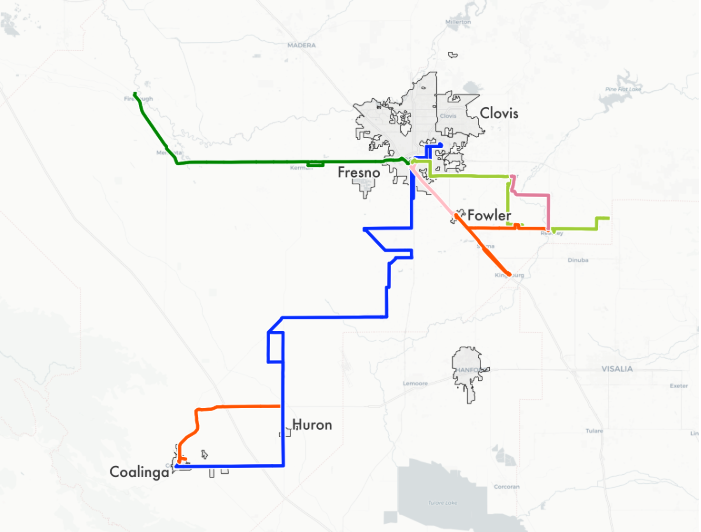
Existing bus fixed-routes in Huron and Fresno area. Credit: SUMC
Green Cruisers
In 2025, LEAP launched its Green Cruisers program, which provides long-term rental of tricycles, e-bikes, and e-trikes to the community for a deposit of $20 per month. Users earn back a dollar on their deposit for each mile ridden during the loan period, effectively making the program free for users who ride frequently. Green Cruisers is one of the four long-term lending bikeshare projects funded through Window 1 of the CMO program. Available bikes for rent include tricycles for users not comfortable balancing, cargo bikes for errands and shopping, and lightweight carbon folding bikes for storage in apartments or taking up stairs.
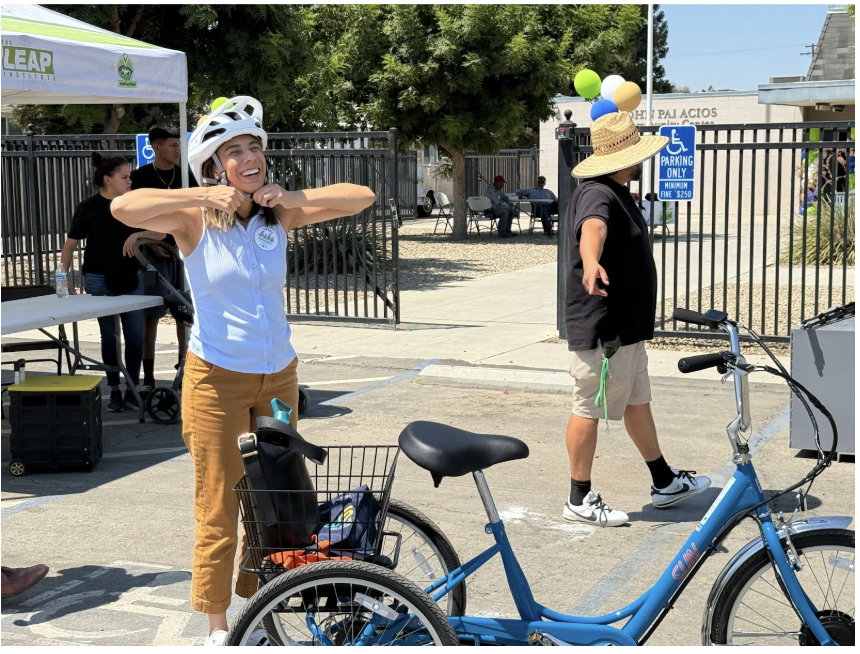
A member of the administrative team at the bikeshare launch event. Credit: SUMC
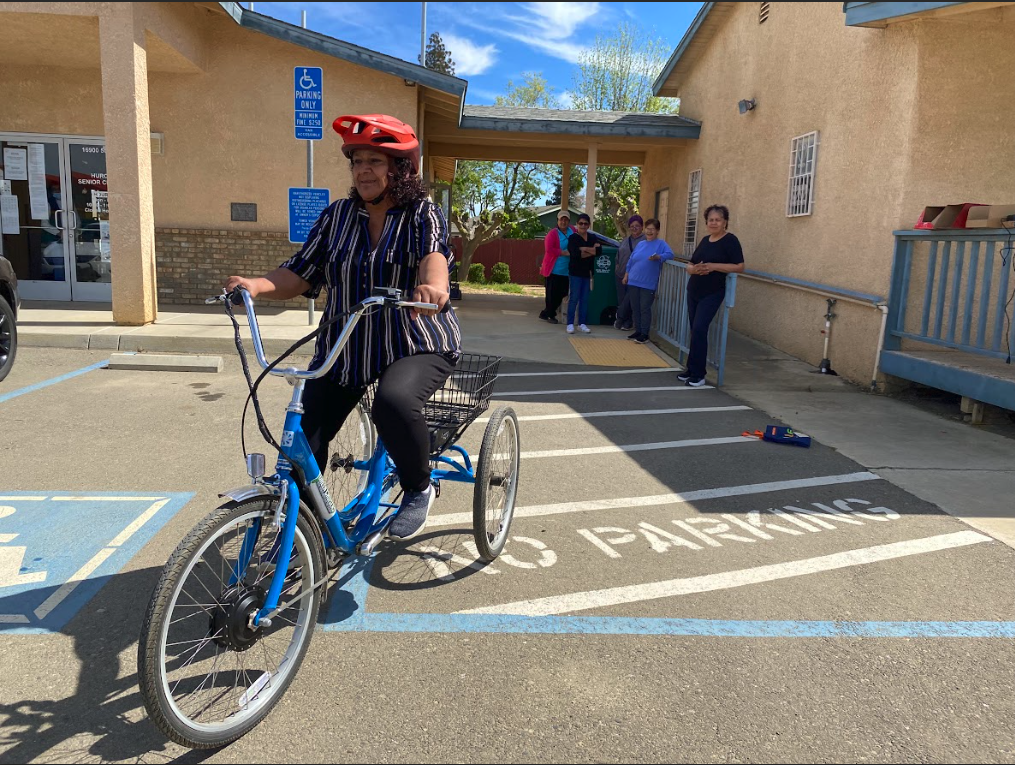
A Huron resident riding a shared tricycle. Credit: The LEAP Institute.
Project Goals
This project’s goals include increasing access to key service areas and public health, employment, and education opportunities. The following are specific goals set by LEAP and the Green Raiteros team through the service:
- To improve local air quality and address the high air pollution due to I-5 freeway vehicle and truck emissions by transitioning to more EVs.
- To improve community health benefits by providing transportation to important medical appointments through the Green Raiteros program and by promoting physical activity riding tricycles, e-bikes, and e-trikes for leisure and local trips through the Green Cruisers program.
- To reduce dependency and stress associated with relying on others such as family or friends who may be busy or have limited capacity to provide rides.
- To reduce dependency on single car ownership and the financial burden of car ownership transportation costs by providing clean, affordable and accessible mobility options.
- To provide ongoing community engagement and community ownership of the Green Raiteros and Green Cruiser programs through collaborative decision-making processes.
- To increase local hiring and workforce development through hiring community members for driver and staff positions and providing programs that promote education and development of youth and community members in the clean transportation field.
Challenges and Lessons Learned
As a growing program, the Green Raiteros has both challenges they’ve overcome and lessons learned from launching and operating the service.
Since Green Raiteros focuses mostly on providing non-emergency medical transportation (NEMT), LEAP has faced both challenges and lessons learned in providing these services. To provide NEMT to community members, LEAP has worked closely with health insurance providers and NEMT brokers to arrange transportation for community members who are unable to transport themselves to their appointments and have medical transportation covered by Medi-Cal or their health insurance.
As the requirements for NEMT providers have evolved over the years, LEAP has adapted its services, pricing for customers, vehicles, and other components to ensure compliance and eligibility. LEAP has also networked and partnered with nearby medical facilities that can pay higher rates, ensuring Green Raiteros can maintain lower pricing for service users. LEAP is working to become an NEMT broker so that community members who visit the Green Raiteros headquarters in Huron looking for NEMT services can be directly connected to Green Raiteros drivers and service.
The Green Cruiser program went through several service model iterations before landing in its current form as a long-term lending program for tricycles, e-bikes, and e-trikes. LEAP initially planned to roll out an e-tricycle system alongside smart docking stations where the e-tricycles could recharge their batteries and community members could rest with shade, outlets for personal electronic equipment, and other smart features. With high insurance costs for e-bike and e-trike programs, LEAP pivoted to manual tricycles and partnered with outside mobility providers to help cover larger insurance expenses, however, it proved challenging when potential partners and LEAP did not align in overall goals and mutually beneficial terms of partnership.
Despite those challenges, LEAP moved forward with launching the Green Cruisers program in fall 2025. The program serves the senior population and local student population. LEAP is providing ongoing community engagement activities and events such as group rides and information sessions to encourage Huron residents to sign up for the program.
Future Plans
LEAP is working to turn Green Raiteros and Green Cruisers into model programs that can be replicated to other communities across California that can benefit from similar services. LEAP has expanded the service to other communities with large farmer worker populations including Pajaro Valley and Coachella Valley. As LEAP enters its third year in providing these services to their community, the organization aims to create a profitable and sustainable service that best serves the local community and meets their varied transportation needs.
LEAP is partnering with a technology developer to create a mobile app to make the service more accessible and allow community members to use the Green Raiteros and Green Cruiser services across different geographic regions. As the LEAP team develops greater expertise and understanding of the NEMT landscape, they will grow their leadership in this space and continue to find new ways to innovate and increase cost-efficiency, increase customer satisfaction, and build community trust and engagement.
Technical Assistance: Context, Outcomes and Impact
SUMC provided technical assistance to LEAP from planning to implementation and from ongoing operations and maintenance to long-term sustainability beyond the initial funding agreement.
One example of technical assistance that LEAP received is support in designing a bikeshare program that fits the needs of their community while also meeting the program requirements. While the LEAP team explored various versions of their bikeshare program to fit their projected budget, SUMC provided assistance that highlighted how different changes to the service model and implementation approach would impact community members, LEAP staff, the project budget, service launch timeline, and other aspects. These considerations included the differences between the following:
- Customer experience with an e-bike or e-trike service vs. a manual bike or trike service
- A traditional docked bikeshare service vs. a long-term lending or rental bikeshare service
- Partnering with a contracted mobility operator vs. being the main operator
- Including e-scooters in their service vs. only providing e-bikes and e-trikes
- Using a manual process of tracking travel and trip metrics vs. sourcing telematics and GPS devices to track travel and trip metrics
Conclusion
The Green Raiteros and Green Cruisers initiatives, led by the LEAP Institute, represent a transformative step forward for the City of Huron, California. By leveraging CMO funding, these programs are set to revolutionize mobility in rural communities, shifting from individual car ownership to a community-based fleet model. Introducing electric vehicles addresses transportation needs and aligns with environmental and health concerns, providing a sustainable alternative to gas-powered vehicles.
This endeavor embodies a remarkable collaboration between diverse stakeholders, including community organizations, educational institutions, foundations, and government bodies. The programs not only offer convenient and affordable transportation options, but also take a holistic approach, addressing healthcare access for low-income residents, empowering retired individuals to contribute through volunteer driving, and even facilitating educational opportunities through the Green Raiderz system. As these programs gain momentum and expand their reach to universities, it becomes clear that these initiatives go beyond just transportation; they are empowering communities, fostering job growth, and demonstrating a model of equity, sustainability, and collaboration that can serve as a beacon for other underserved regions. The success of the Green Raiteros and Green Cruiser initiatives is a testament to the potential of community-driven solutions to tackle multifaceted challenges and create a more inclusive and resilient society.