A Review of Shared Mobility in 2025
20 minutes Author: Shared-Use Mobility Center Date Launched/Enacted: Feb 3, 2026 Date Published: February 3, 2026
Introduction
Through knowledge-sharing, technical assistance, and applied research, the Shared-Use Mobility Center (SUMC) tracks the shared mobility industry. In many ways, 2025 was a difficult year for shared mobility in the US, as providers around the country worked to provide essential mobility services while managing funding changes and shortfalls and a rider base that has yet to return to pre-COVID levels. However, despite setbacks, we saw promising innovations and inspiring examples of how shared mobility can modernize cities, expand access, and uplift communities. Below are some of the developments that shaped the shared mobility landscape in 2025.
Originally published February 3, 2026.
The fiscal cliff became the reality faced by transit agencies across the country.
The 2021 Coronavirus Aid, Relief, and Economic Security (CARES) Act provided an essential stopgap as ridership losses accompanying the COVID-19 pandemic left severe gaps in operating budgets for agencies large and small. As CARES Act funds were exhausted by many agencies in 2025, policymakers and transportation providers shifted from preparing for an impending deficit and into the implementation of difficult and often drastic decisions on how to continue transit service.
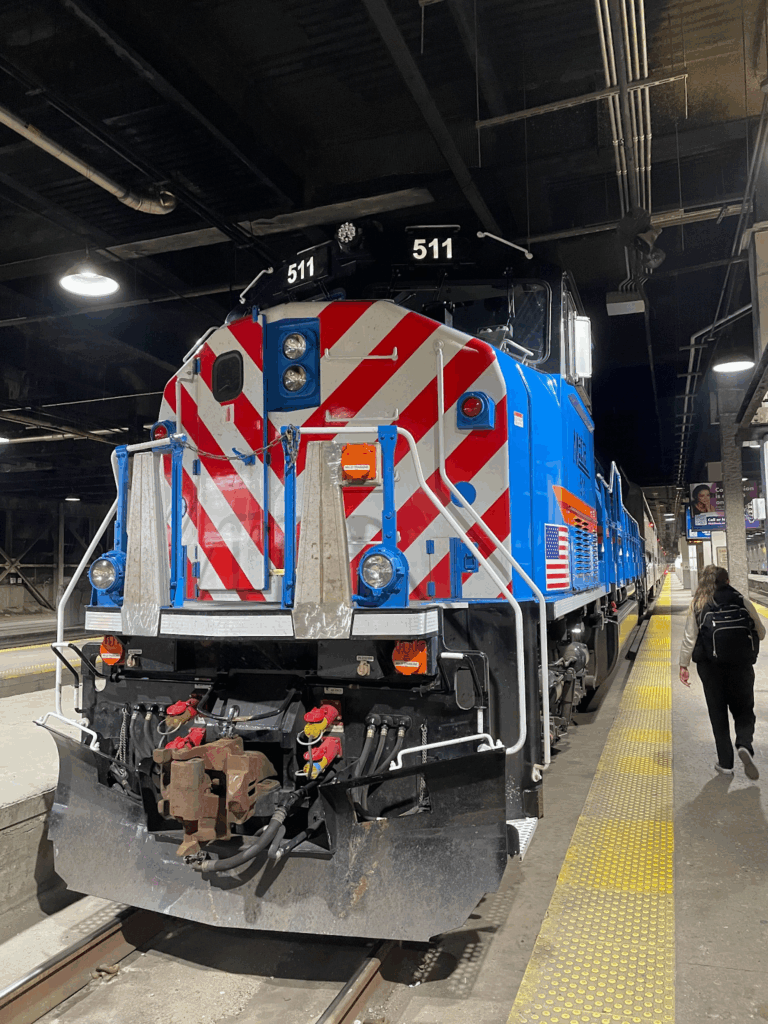
A Metra train at Union Station in Chicago. Credit: SUMC.
Agencies around the country took a variety of approaches last year to address budget gaps. In June, the Southeastern Pennsylvania Public Transportation Authority (SEPTA) in Philadelphia, PA, was forced to make significant service cuts, freeze hiring agency-wide, and raise fares to fill a $213 million budget deficit. These changes came after the state legislature failed to provide sufficient support for public transit. While the Pennsylvania Department of Transportation was able to flex $153 million in highway funds to temporarily support SEPTA, this was only meant to last through the state’s fiscal 2025, which expired in June. While the full extent of these measures have yet to be seen, observers fear these cuts will be severe and long-lasting, limiting access and economic growth.
Meanwhile, in Illinois, the General Assembly passed a groundbreaking transit funding and reform bill in October, helping the Chicago Transit Authority (CTA) and other Illinois transit providers avoid the fiscal cliff. The bill included $1.2 billion in operating funding for the Chicago-region agencies of CTA, Metra, and Pace Suburban Bus, and allowed them to continue operations and pursue service improvements without service cuts or fare increases. The law included several new revenue sources, including a 0.25% sales tax, a redirection of motor fuel tax monies previously allocated only to road projects, and a new rideshare congestion surcharge. The bill also included a major transformation of transit governance in the region, which is discussed below in more detail.
Other agencies, like Bay Area Rapid Transit (BART) in California, continued to operate on emergency funds that will run out in the near future, and the search for ways to balance the budget continued.
Agencies prioritized transit access through zero-fare transit, but debate continued about its cost and impacts.
Zero-fare policies have expanded in recent years, with many launched as a response to the pandemic-driven decline in ridership. Advocates of zero-fare transit view it as a strategy to improve transit access by removing financial barriers to riding. In 2025, this rather niche topic saw wider public recognition when Zohran Mamdani won the New York City mayoral race on a platform that included the elimination of bus fares as part of his affordability agenda. These programs are frequently framed as tools to improve accessibility, enhance service efficiency, and make it easier for people to access essential services and opportunities.
Several transit agencies launched zero-fare pilots on select services in 2025. The Jacksonville, FL, transit agency implemented a pilot program to make the NAVI autonomous shuttle service free starting in December, after a brief zero-fare service during its launch in June 2025. The Montgomery (MD) County Department of Transportation began offering zero-fare on all Ride On transit services, including fixed-route, limited stop, on-demand, and bus rapid transit services in June. Michigan City (IN) Transit launched a zero-fare program for fixed-route and ADA paratransit services in December 2025. Other agencies offered programs targeting low-income riders, such as Philadelphia’s program, or implemented temporary zero-fare policies in response to federal benefit disruptions, as seen in Lake County, OH, during Supplemental Nutrition Assistance Program (SNAP) limitations.
Some agencies that previously offered free rides reinstated fares, often with exceptions for low-income and or unhoused individuals. In April, after 5 years of zero-fare bus service, the Kansas City Council voted for a funding plan that reinstated regular and discounted bus fares for the region’s transportation authority. In Los Angeles, the city’s Department of Transportation restored fare collection on its DASH bus network in February to support continued service improvements and wage increases for drivers.
More information on the nuances of fare-free transit can be found in the Zero Fare Transit State of the Industry whitepaper on SUMC’s Mobility Learning Center.
Major governance changes were underway in several regions.
Some funding and efficiency challenges were marked by big shifts in how transit providers served large areas, and some questioned whether a single agency could effectively serve a large region at all. In the Dallas-Fort Worth region of Texas, several cities, including Irving, Carrollton, Farmers Branch, Plano, and Highland Park, contended that the Dallas Area Rapid Transit (DART) did not provide adequate suburban service and argued that they contribute more to DART than they benefit (although the reality is more complicated). This conflict culminated in the DART board approving service cuts and fare increases, and the suburbs will hold special elections in May 2026 to decide whether they will leave the DART system altogether. Proponents of a suburban exit assert that individual communities can serve their own transportation needs more efficiently, while opponents worry that this move will make regional transportation more difficult and costly, particularly for those who rely on the system the most.
Similarly, several Des Moines suburbs voted to withdraw from the Regional Transit Authority (also abbreviated DART), citing low suburban ridership and dissatisfaction with the funding formula. The City of Grimes formally withdrew from the system in June, while Pleasant Hill and Bondurant also voted to do so in 2026 and 2027. This comes as the agency approved its Reimagine DART plan in December, redesigning the bus network to adapt to shifting travel patterns, address financial issues, and better align services with demand across member communities. The redesign promises more frequent service and several new microtransit zones, at the cost of a reduction in the number of bus routes, and was partly crafted in light of an agreement between member cities to avert more suburban community withdrawals.
Other regions took the opposite tack, looking to expansion or consolidation as a governance strategy. Under the Illinois transit funding bill passed in October, Chicago’s three transit providers (Metra rail, Pace Suburban Bus, and the CTA), along with their oversight entity, the Regional Transportation Authority, will be reorganized and consolidated under a new regional entity, the Northern Illinois Transit Authority (NITA). The reorganization aims to modernize and align priorities and services of these formerly independent (and often bickering) systems.
Connect Transit, serving the Bloomington-Normal, IL, area, took over rural transit services formerly provided by Show Bus in July. Connect Transit maintained the previous zero-fare, on-demand service model, renaming the service Connect Go. The county-wide effort aimed to stabilize rural service and opens the door to potentially expand service to neighboring counties.
State DOTs played a more direct role in supporting shared mobility and public transit.
In 2025, many state departments of transportation (DOTs) grew their support of shared mobility, expanding their role as funders and strategic federal pass-throughs. Faced with shifting travel behavior, fiscal uncertainty, and growing access demands, many state DOTs expanded their roles by coordinating transit partners, shaping policy frameworks, and guiding implementation of both pilots and new programs.
State DOT leaders convened at a series of virtual workshops on transit innovation, co-hosted by SUMC and the American Association of State Highways and Transportation Officials (AASHTO) in partnership with the Federal Transit Administration. Over four virtual sessions, state transportation leaders shared lessons on integrating shared mobility into system planning, procurement, and service delivery. Others discussed emerging practices, partnership opportunities, and strategies for aligning shared mobility with state and regional goals.
The North Carolina Department of Transportation continued its “Mobility for Everyone, Everywhere (MEE)” initiative, which expanded on-demand transit and flexible service models across North Carolina in partnership with local agencies. Small and often rural agencies received guidance, funding, and technical assistance to tailor new microtransit services to better serve their communities.
Through California’s Clean Mobility Options (CMO) program, the state’s Air Resources Board and their nonprofit partners provide funding and targeted support to transportation projects in some of the state’s most disadvantaged communities. In 2025, CMO-supported projects expanded shared mobility options for California communities, from on-demand electric shuttle services in Costa Mesa and El Cajon, to expanded electric carsharing in Fresno and San Diego. In addition, CMO awardees also received funding for initiatives like bikeshare expansions in San Joaquin County and electric vehicle sharing in Riverside and Tulare Counties. These projects were supported not only through state funding vouchers but also with technical assistance on procurement and implementation.
More cities and transit agencies experimented with emerging technologies.
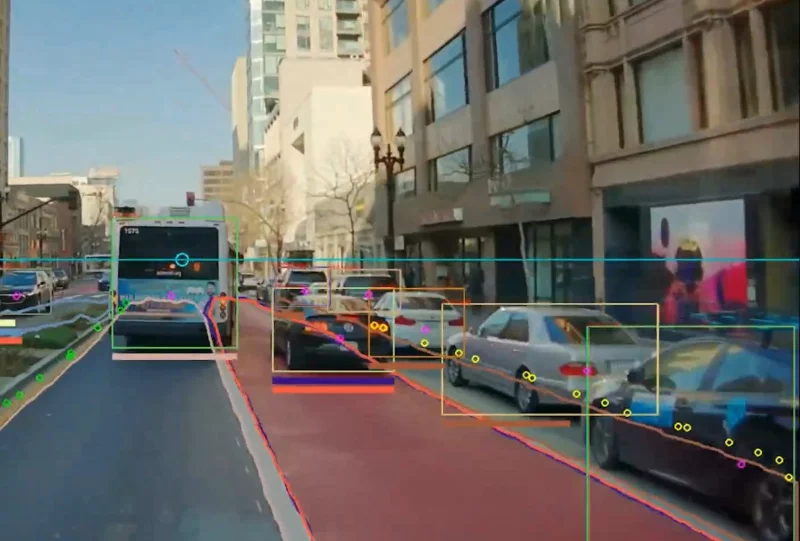
Caption: A street in Oakland, CA, viewed through AI-enhanced cameras from the start-up Hayden AI. Credit: NPR and Hayden AI
A number of tech innovations, particularly artificial intelligence (AI) and advanced vehicle automation technologies, helped improve service reliability, safety, and rider experience. Among the visible examples of practical AI in 2025 were transit agencies using the evolving tech directly on transit vehicles to enforce transit-only areas, detecting and recording vehicles blocking dedicated lanes and automatically issuing tickets via mail. While many agencies were still only piloting these tools, cities like Chicago and New York widely deployed the AI enforcement cameras, resulting in notable service improvements—the New York Metropolitan Transit Authority cited a 5% speed increase along some AI-monitored routes and said more than 80% of vehicles cited in bus lanes did not commit a second offense.
Agencies also experimented with evolving autonomous vehicle (AV) technology and trip-planning applications. In late 2025, SUMC attended the Transportation Summit in Minneapolis, MN, where practitioners gathered to discuss how vehicle automation can support safer and more efficient shared mobility and transit. Speakers discussed how AI and AV technologies can work to keep both drivers and pedestrians safer, while also improving performance and routing. On the ground, transit agencies have already started to adopt this technology by investing in AVs and experimenting with AI software to further improve on-time performance when paired.
Agencies also experimented with trip-planning improvements that included more multi-modal options and showed real-time operations. This trend was not exclusive to urban areas with bikeshare or scootershare; suburban and rural areas also began to include connections to on-demand services, and even regional or national service providers like Amtrak.
Communities are using microtransit to fill service gaps.
Designed to complement fixed-route services, microtransit offers flexible travel, often serving areas that traditional fixed-route transportation can’t reach or has trouble serving with enough frequency. In 2025, on-demand service models grew increasingly popular. The year began with the strongest quarter yet for microtransit implementation, with over 100 new projects launched globally. North America was the strongest region in the world for new on-demand implementations, with 55 new projects launching in the first half of 2025.
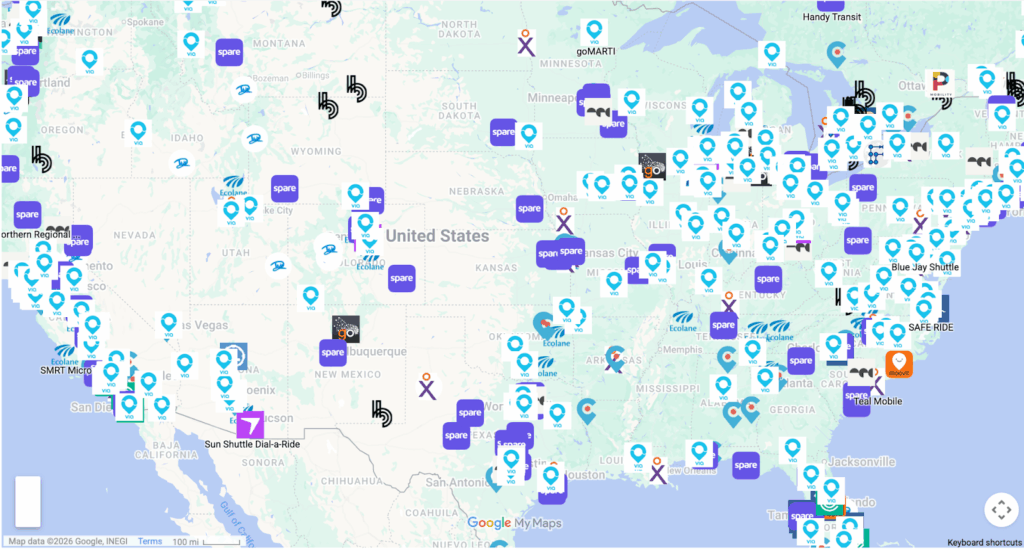
Microtransit operations in the continental US categorized by their operator. Credit: Lucas Foljanty
This shift shows a response to evolving travel patterns and service gaps that have persisted since the pandemic. Work schedules and locations have shifted for many workers, with an estimated one-half to two-thirds of working Americans holding hybrid or fully remote positions, meaning that travel demand is no longer concentrated in traditional peak hours or radial commutes. As a result, hub-and-spoke transit systems designed around 9-to-5 commuter trips are no longer meeting the needs they once did. At the same time, riders are relying on public transportation to make a greater variety of trips throughout the day, including for shopping, healthcare, and family and community activities. On-demand services offer a flexible way to respond to these changes, better aligning transit service with how, when, and where people travel today.
In 2025, transit agencies also implemented and expanded on-demand services to serve specific niches within their communities. Programs like SouthWest Transit’s SW Prime in the suburban Twin Cities demonstrate how microtransit can complement fixed-route services by improving access to them. Others, like Cecil County, MD’s COMPASS, have been tailoring their on-demand services to reach specific communities—in this case, people in recovery from addiction, providing transportation to services to support recovery efforts. As this trend continues to grow, microtransit and on-demand services will remain as critical supplements to fixed route transit, and further help communities fill mobility gaps.
For more information on microtransit, explore SUMC’s Microtransit Learning Module.
Cities and states invested in active transportation, with ridership at record levels.
From investments in biking and bike-based cargo to new shared micromobility systems, 2025 saw growth in active transportation. Around the country, cities like New Haven, CT, Columbus, OH, and Minneapolis, MN partnered with micromobility providers to launch scootershare and bikeshare programs. Other micromobility systems, including RTC Bike Share in Las Vegas, Bay Wheels in the Bay Area, and Capital Bikeshare in Washington, D.C., expanded in 2025 to new cities and communities. Several cities recorded record-breaking micromobility ridership, including Divvy in Chicago, which had nearly 13 million bikeshare and scootershare trips last year, and CitiBike in New York, which saw its highest single day of ridership ever on August 2, 2025.
Around the country, communities continued to explore new ways for e-bikes and other human-scale vehicles to solve transportation challenges. In Portland, OR, a six-month zero-emission delivery zone pilot spurred delivery companies to expand e-cargo bike fleets. The Portland Bureau of Transportation (PBOT) pilot, which ended in March 2025, prioritized zero-emission delivery vehicles across downtown, providing exclusive loading-zone access to cargo bikes and other zero-emission vehicles in preference to larger, more polluting trucks and vans. PBOT deployed a digital parking pass and curb management system, connected companies with e-cargo bike and trike manufacturers, designated cargo bike routes, and explored policies and programs, like “cyclelogistics micro distribution hubs,” to increase commercial deliveries by bike.
In Northampton, MA, Pedal People, a worker-owned recycling, waste, and compost management cooperative, showed last year that essential city services, even those that deal with hauling large loads, can operate entirely with pedal power. Pedal People exclusively uses bicycles and bicycle trailers for their waste pickup and freight services, and is another example of how human power and mechanical advantage can support essential services.
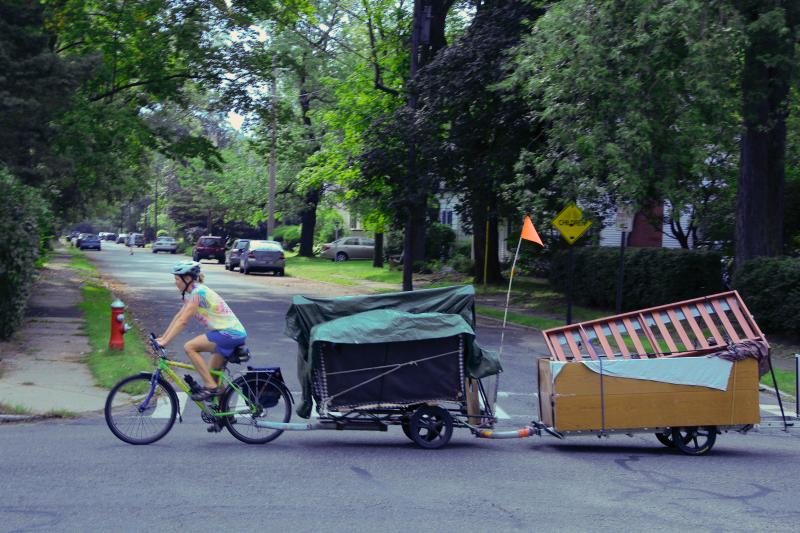
Credit: Pedal People
Several new state programs took advantage of e-bikes’ ability to reduce congestion and carbon emissions by replacing many car trips, offering incentives for e-bike purchasers. In April, Washington launched the WE-bike rebate program, funded by the state’s Climate Commitment Act, offering up to $1,200 for eligible applicants. The same month, Massachusetts launched its own statewide e-bike incentive program through the Mass Clean Energy Center, also offering $1,200 vouchers to low- and moderate-income residents. California’s statewide E-Bike Incentive Project returned for its second round in May. Funded by the Air Resources Board, the program provided eligible participants with vouchers worth up to $2,000 towards the purchase of an e-bike, e-cargo bike, or adaptive e-bike. The program ended in December after distributing over 2,000 vouchers.
New carshare approaches helped communities reduce car ownership and fill mobility gaps.
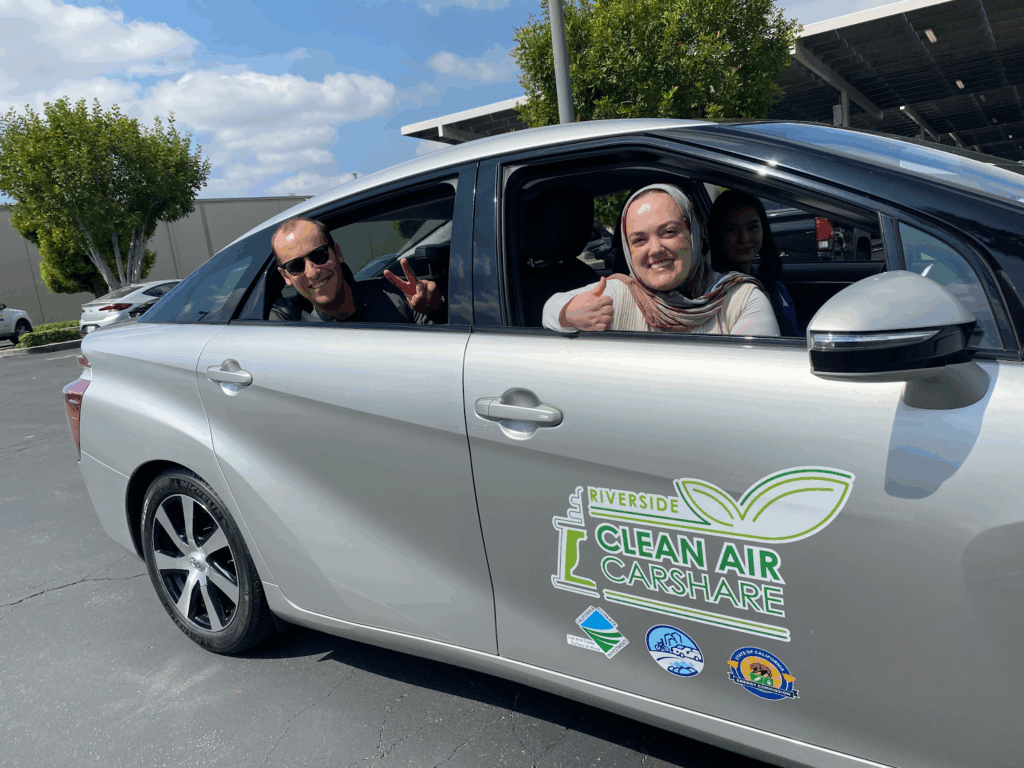
Riverside Clean Air Carshare, the first hydrogen-powered carshare system in the US. Credit: SUMC
Around the country, cities continued to develop policies and implement programs using carshare to provide more clean shared transportation. The City of Sacramento, CA, partnered with Zipcar and Breath California Sacramento Region to offer the Our Community CarShare Sacramento (OCCS) program, which made electric vehicles (EVs) available to income-qualified residents. In 2025, OCCS expanded under the City’s EV Blueprint to include three additional public locations, bringing the total number of sites to 11. Elsewhere in California, Riverside Clean Air Carshare launched in April as the first hydrogen-powered carshare service in the US.
In North Carolina, the City of Charlotte launched Carolina Carshare, an EV carshare pilot bringing affordable, reliable, and environmentally sustainable transportation to one of the city’s most historically disinvested corridors. Charlotte is one of 13 cities nationwide selected to receive grant funding through a national community carshare pilot, the Affordable Mobility Platform. The City of Boulder implemented EV carsharing to increase mobility options and reduce transportation emissions, partnering in 2025 with the nonprofit Colorado CarShare to place a shared EV in a downtown parking garage. This new deployment, one of more than a dozen in the city and many more in the wider region, supports an effort to reduce transportation emissions by expanding shared mobility options downtown.
The venerable Blue LA carshare in Los Angeles ceased operations in April 2025 after nearly seven years of operation. Blue LA was one of the nation’s first electric vehicle carshare programs designed to serve low-income residents and historically underserved communities. The Los Angeles Department of Transportation (LADOT) chose not to renew the operating contract with Blink Mobility and instead paused to reassess how best to use the remaining funding to support community transportation needs. In November 2025, LADOT announced a new partnership with it’s electric, a curbside charging company. Through this initiative, LADOT will construct more Level 2 charging stations across select corridors, replacing a number of units previously used by Blue LA. This shift reflects LADOT’s broader strategy to expand access to EV infrastructure while exploring various approaches to equitable shared mobility.
NYC’s Congestion Pricing showed benefits from day one.
After years of planning and a rollout dragged by political challenges, New York City’s congestion pricing went into effect in January 2025, with tangible benefits following nearly immediately. The program, first of its kind in the US, charges most motor vehicle traffic entering a Congestion Relief Zone covering most of Lower Manhattan between 5:00 am and 9:00 pm on weekdays, and aims to encourage drivers to switch to public transit or other low-emission modes. Within weeks, the program led to measurably reduced traffic congestion in Manhattan, increased subway ridership, improved travel times, and a host of other benefits, and is on track to raise billions of dollars to support public transit. While the program continues to face political challenges, it demonstrates that bold policy can incentivize people-focused mobility and make for safer, cleaner, and less congested cities.
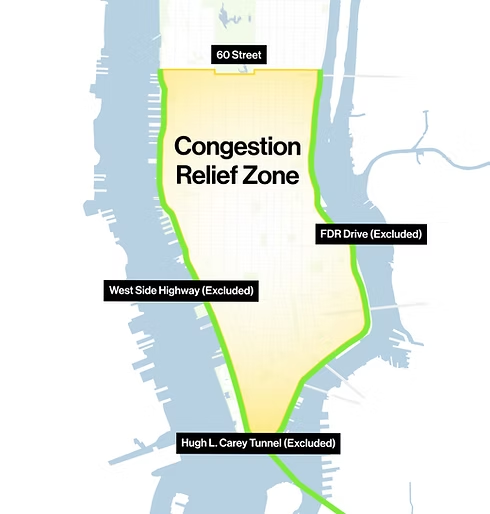
Map of the Congestion Relief Zone. Credit: MTA
Conclusion
From fiscal cliff responses and agency reorganizations to zero-fare policies and microtransit expansion, transit providers and state DOTs worked in 2025 to navigate complex and evolving mobility needs in the US. At the same time, new technologies and modes demonstrated how transportation can better support health, climate, and economic outcomes, especially when paired with intentional policy and collaboration.
While uncertainty remains around some elements of the shared mobility world, including long-term funding or governance, the lessons from 2025 highlight the importance of flexibility, cross-sector coordination, and sustained public investment. The strategies tested in 2025 offer both cautionary insights as well as pathways for building transportation systems that are more resilient and responsive to the needs of the people they serve.
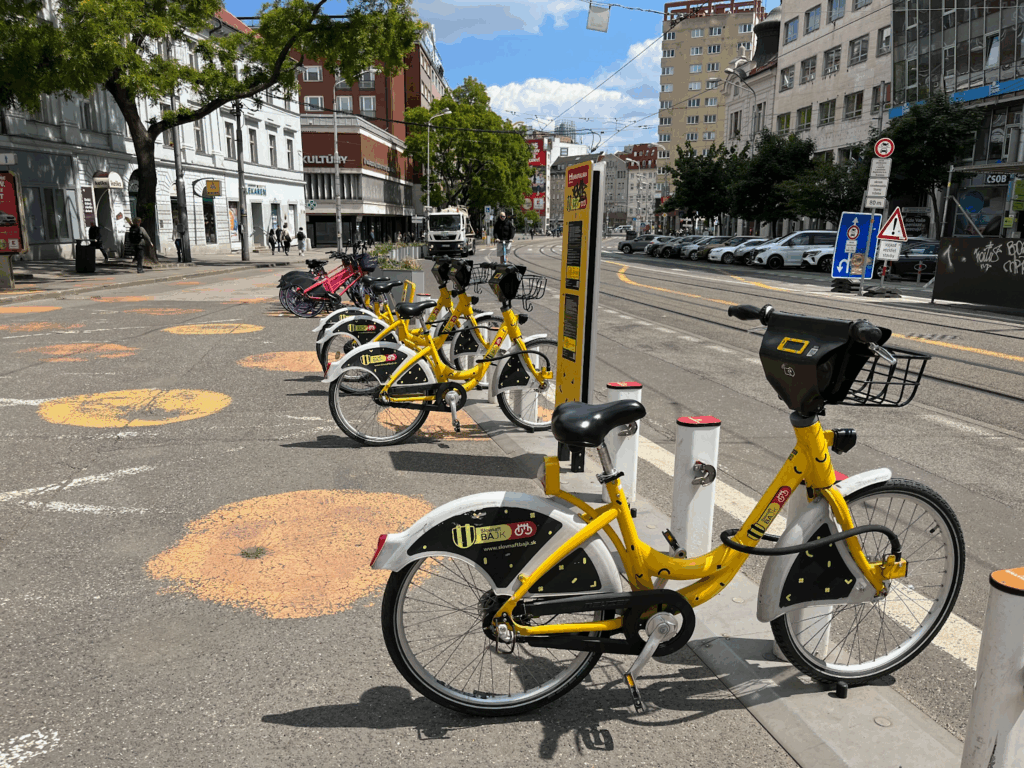
Bikeshare in Bratislava, Slovakia. Credit: SUMC