Free Ride Around National City (FRANC): Zero-emission Shuttle Program in National City, California
10 minutes Author: Shared-Use Mobility Center Date Launched/Enacted: Mar 17, 2026 Date Published: March 13, 2026
The Clean Mobility Options (CMO) program is a California Air Resources Board (CARB) statewide public pilot program that empowers under-resourced communities across California to better understand and overcome mobility obstacles by providing funding for Community Transportation Needs Assessment (CTNA) and Mobility Project Voucher (MPV) to support clean, shared, zero-emission transportation projects. The program has awarded $66.5 million across 73 communities. Window 1 of the MPV program provided vouchers of up to $1.8 million each to 20 MPV awardees across California.
CARB selected the Program Administrator (PA) team, including CALSTART, Shared-Use Mobility Center (SUMC), emergent labs, and Heartquist Strategies, to provide comprehensive technical assistance to these communities from application to implementation, making this critical funding more easily accessible to eligible applicants.
SUMC serves as the technical lead for the program, providing technical assistance, evaluation, and program design. SUMC’s vision is that all people have access to joyful, dignified, equitable, safe, reliable, and affordable transportation options, regardless of whether they own a car. This vision is applied to our work with CMO awardees. SUMC’s team of cohort facilitators and researchers connect, equip, and empower awardees through the tool and resource development, program evaluation and analysis, and the Clean Mobility Equity Alliance (CMEA). Working closely with each awardee, our team supports decision-making, knowledge gathering, and operational insights, enabling planning, implementation, and sustainability.
Video featuring Pedro García, Economic Development Manager, National City; Diane Takvorian, Executive Director and co-founder of the Environmental Health Coalition (EHC); Sandy Naranjo, Vice Chair & National City Appointee, Port of San Diego; Ditas YamaneDistrict 3 Council Member in National City, and the resident Alicia Sanchez talking about how National City is utilizing CMO funding to introduce the city’s inaugural zero-emission shuttle program, FRANC. Credit: SUMC
A Snapshot of National City, California
National City is located in San Diego County in Southern California. With a population of 56,173 at the 2020 United States census, National City has seen its population decrease in recent years (from 58,582 at the 2010 census), yet it still hosts a dense population of roughly 6,200 people per square mile. As part of the South Bay corridor, National City is situated along key transit routes and emerging projects, such as the proposed Purple Line commuter rail.
National City faces environmental challenges, with a pollution burden of the 79th percentile according to the CalEnviroScreen 4.0, and residents in some parts of the city experience diesel pollution exposures exceeding 80% of other state areas. Its median household income of $64,284 is well below the state’s median of $99,122.
Free Ride Around National City (FRANC)
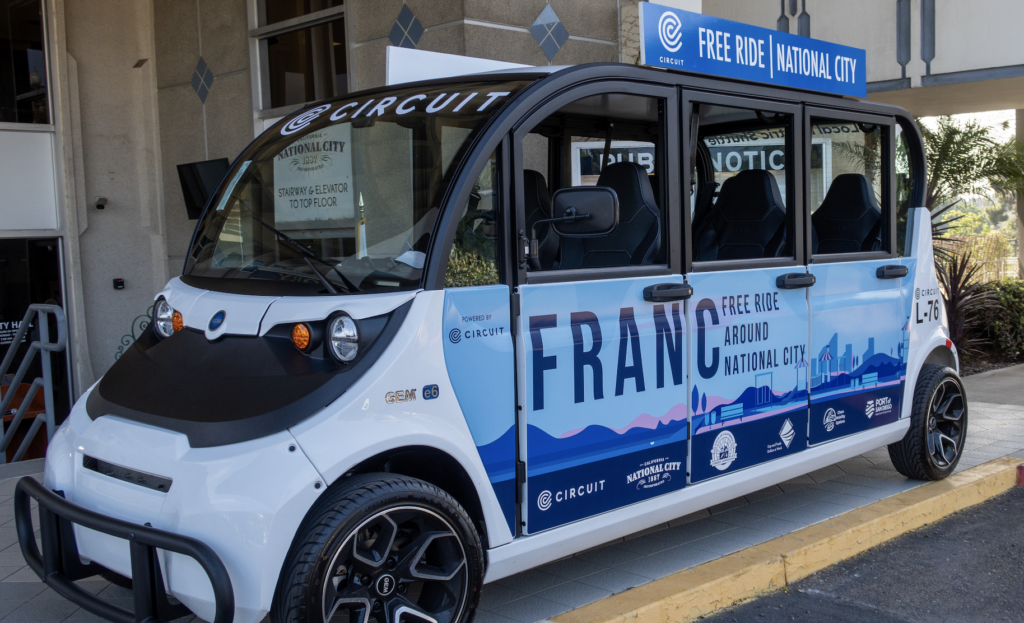
The City of National City is utilizing CMO funding to introduce its very first zero-emission free-of-cost shuttle program. Operating with two neighborhood electric vehicles (NEVs), the FRANC’s fixed route service seamlessly connects commuters and serves as a first/last mile solution to the existing transit hub. The service covers trips from and to anywhere within the service area, including the 8th and 24th Street Trolley Stations, the Navy Base gates, the National City Aquatic Center, Kimball and Pepper Park, and local schools, shops, and restaurants.
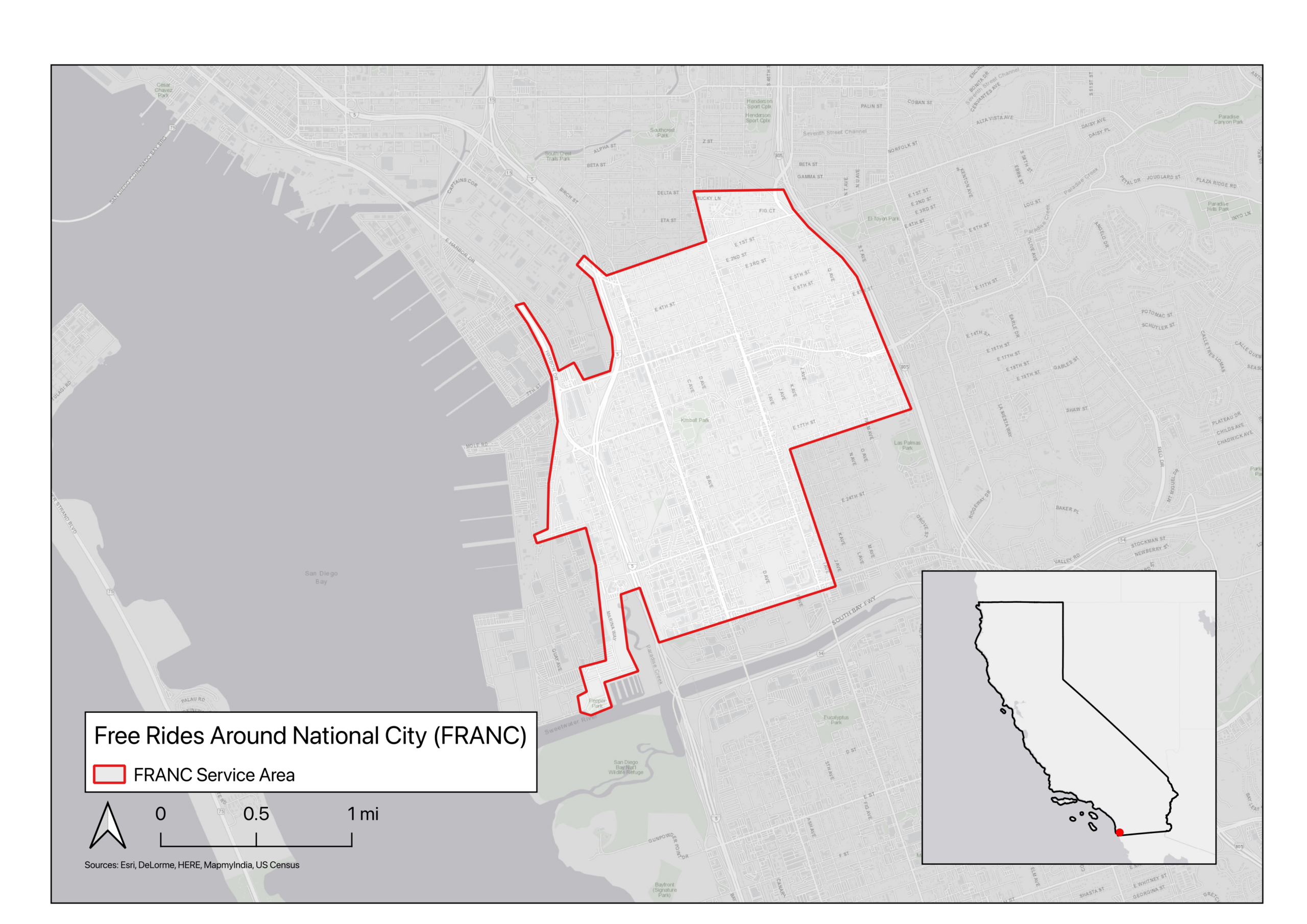
FRANC service area. Credit: Circuit/ Google Maps.
Project Details
| Funders | California Air Resources Board, California Climate Investments, California Energy Commission |
| Funding | $1,800,000 |
| Awardee | National City |
| Award Partner | Circuit, KTUA |
| Location | National City |
| Project | Free Ride Around National City (FRANC) |
| Administrative Team | CALSTART, Shared-Use Mobility Center, emergent labs, Heartquist Strategies |
Microtransit Projects
In Window 1, eight MPV awardees are implementing microtransit services, and six projects have launched and continued operation since 2023, including FRANC. Microtransit, or on-demand shuttle, is the most common mobility mode funded by the CMO program. Microtransit offers point-to-point service, much like ride-hail, and can be booked via an app or by phone. Users can pay either via the app or in cash; most services charge either less than $2 per ride or offer free rides.
Project Goals
The FRANC electric shuttle service offers a range of benefits to the community. Creating local jobs, providing free transportation options, and serving as a first-/last-mile solution to existing transit hubs. The on-demand service is 100% electric, avoiding greenhouse gas emissions and reducing vehicle miles traveled (VMT). The project goals include:
- Increase connectivity to key destinations in the Homefront and Waterfront area.
- Increase accessibility for sailors, students, and seniors to jobs, transit, and mobility choices.
- Create a centralized mobility hub for future clean transportation modes/options.
- Reduce transportation costs.
- Engage likely service users interested in the project.
- Reduce greenhouse gas emissions.
- Reduce single-occupancy vehicle driving during peak commuting time.
- Maintain service operations for at least 4 years.
- Local workforce development.
Project Operations
Ridership Statistics:
In the initial months of operation, FRANC experienced high ridership, reaching approximately 5,907 trips in the first quarter. The service has maintained a robust ridership, averaging 7,888 rides and 936 users in the first quarter of 2025.
Operational Schedule:
The microtransit service operates from 6:30 AM to 7 PM Monday through Friday and from 10:00 AM to 7:00 PM on weekends, ensuring accessibility during crucial hours for residents. Rides are currently free of charge. Gratuities for Circuit drivers are appreciated but never required.
Technology Integration:
Circuit operates FRANC and ensures people ride together in the same direction, further optimizing efficiency and minimizing environmental impact. FRANC can be scheduled through the Circuit smartphone app available on Google Play or the App Store.
Key Destinations:
FRANC focuses on several key destinations within its service area, including National City Aquatic Center, Kimball and Pepper Park, local schools, shops, and restaurants.
Project in Numbers
Project launched in September 2023
| Data by 2024 |
| Unique Users: 1,947 |
| Trips: 22,665 |
| Average Trip Distance: 2.27 |
| Vehicles: 2 |
| Jobs: 5 |
| Top Destinations |
| Pepper Park |
| National City Aquatic Center |
| Kimball Park |
| Local schools, shops, and restaurants |
Challenges and Lessons Learned
- National City is installing chargers, solar panels, and an NEV storage area at the 8th Street Trolley Station. The location was strategically determined as the on-demand shuttle provides first-and-last mile connection between the trolley station and final destinations.
- The City initially faced a challenge finalizing an agreement with the local transportation authority, San Diego Metropolitan Transit System (MTS), which delayed the City’s timeline in commencing construction of the mobility hub.
- Due to the timing of finalizing the inter-agency agreement, the City had to go through the bidding process twice, resulting in an increase in construction costs.
- The City was also subject to delays in coordinating the interconnection with SDG&E, but expects to complete the project by summer 2026. Once operational, the solar-powered charging station is expected to offset the electricity required to power all three NEV shuttles.
Future Plans
National City plans to add a third neighborhood electric vehicle (NEV) and modify service hours to better meet service demand. The City is also exploring a fee structure to mitigate increased wait times and to curb ride request cancellations.
Technical Assistance: Context, Outcomes and Impact
The Program Administrator team provides technical assistance related to program compliance and requirements. One component of the program is user surveys and project reporting. SUMC led the design of user surveys and reporting based on an evaluation framework. Since each awardee’s mobility project is designed based on a community needs assessment, the team assists the awardee in modifying to reflect its program.
One of the perks of being a PA is understanding how other awardees implement these user surveys, especially if the awardee is working with the same operator. By the time National City launched its service and was ready to implement its user surveys, the PA team had provided guidance on how a similar project with the same operator had implemented its user surveys. This allowed National City to implement user surveys more quickly.
CMO awardees are part of the peer-to-peer network exchange called the Clean Mobility Equity Alliance (CMEA), which is overseen by the Shared-Use Mobility Center. CMEA holds regular meetings and trainings to support awardees. In the past, CMEA has held meetings on transportation and mobility equity, electric vehicle charging infrastructure, the Electric Vehicle Infrastructure Training Program, and storytelling and data visualization. Awardees are also invited to participate in Equity and Long-Term Sustainability Working Groups.