EZfare and Beyond: NEORide’s Pursuit of Innovative Transit Technology through Interagency Collaboration: 2025 Update
20 minutes Author: Shared-Use Mobility Center Date Launched/Enacted: Dec 18, 2025 Date Published: December 18, 2025
Summary
- In 2020, NEORide, a council of governments focused on improving transportation coordination, received an Integrated Mobility Innovation grant from the Federal Transit Administration to launch EZfare, an account-based mobile ticketing system.
- Since its launch, EZfare has expanded to include more NEORide partners and now hosts more features to make fare payments more seamless and user-friendly for nearly 20 transit agencies across 6 states.
- Building upon EZfare’s success, NEORide has piloted various programs to improve regional transportation, including EZConnect, a one-click/one-call program that serves agencies in different geographies by pairing riders with on-demand human transportation services.
- Due to its organizational structure, geographic footprint, and innovative projects, NEORide has positioned itself as an industry leader in promoting coordination between transit agencies and supporting regional mobility.
Description: Video interview with Katherine Conrad, Executive Director of NEORide Credit: Shared-Use Mobility Center (SUMC)
This project is part of the Mobility Innovation Collaborative (MIC). The MIC provides a comprehensive suite of technical assistance resources, promotes knowledge sharing activities, and captures stories and lessons learned from innovative mobility projects across the United States.
Originally published December 2025.
Introduction
For thousands of transit riders across the country, completing a journey may include crossing county or even state lines, transferring between services, or using multiple modes of transportation. Often, the multi-leg nature of these trips requires riders to purchase tickets for each transit service, using multiple different payment methods and platforms. This unintuitive fragmentation can be confusing, creates a burden to the rider, and may often discourage public transit use. As transit agencies continue to work on improving rider experience, service coordination and fare payment integration are key considerations.
EZfare was developed and launched by NEORide, a council of governments spanning several states and dedicated to improving coordination among small and medium-sized transit agencies, with support from a Federal Transit Administration (FTA) Integrated Mobility Innovation (IMI) grant. The EZfare approach centers on an account-based ticketing solution that allows users to find and purchase fares through a mobile or web application. Since its launch in 2020 with a small handful of participant agencies, EZfare has expanded to more transit providers and added features to make fare payments as seamless and user-friendly as possible. EZfare is an innovative fare integration solution, and the lessons learned about interagency coordination and collaboration have helped NEORide continue to innovate in fostering more integrated regional transportation networks.
This case study builds on SUMC’s 2022 case study focused on the planning and launch of EZfare, discusses some of the ways EZfare has evolved since the IMI program, and highlights some of NEORide’s other initiatives to improve regional mobility.
Formation and Growth of NEORide
Since its formation in 2014, NEORide has been an industry leader in facilitating cooperation and integration between transit agencies. NEORide is a council of governments made up of agencies and other governmental organizations to support public transit coordination. Originally made up of three founding transit agencies in Ohio, the organization has since grown to over 40 participating members in 11 states, and continues to expand.
NEORide is open to any governmental agency, including transit agencies, cities, counties, and other public entities that operate transit. Prospective members sign a participation agreement with NEORide, highlighting the specific benefits and services they plan to adopt, and pass a resolution to agree to NEORide’s bylaws and regulations. After joining, each member has an equal vote on the NEORide board.
NEORide members share branding, resources, marketing, and best practices, helping strengthen each individual agency, setting the stage for more effective regional coordination, and improving the transit landscape at large.
A key functional aspect of NEORide is its joint procurement program, which leverages members’ combined buying power to secure equipment and technology at more competitive prices than individual agencies might be able to command. Small and mid-sized transit agencies often lack the capacity, political influence, or market leverage to obtain favorable pricing on their own. By banding together through NEORide, these agencies can negotiate better contract terms, reduce administrative burdens and procurement timelines, and achieve the cost savings and efficiencies of economies of scale. In this way, NEORide allows partner agencies to maximize the impacts of available resources through interagency collaboration.
NEORide also spearheads training programs, technical assistance initiatives, and technology projects to build local agency capacity, support interagency interoperability, and improve regional transportation.
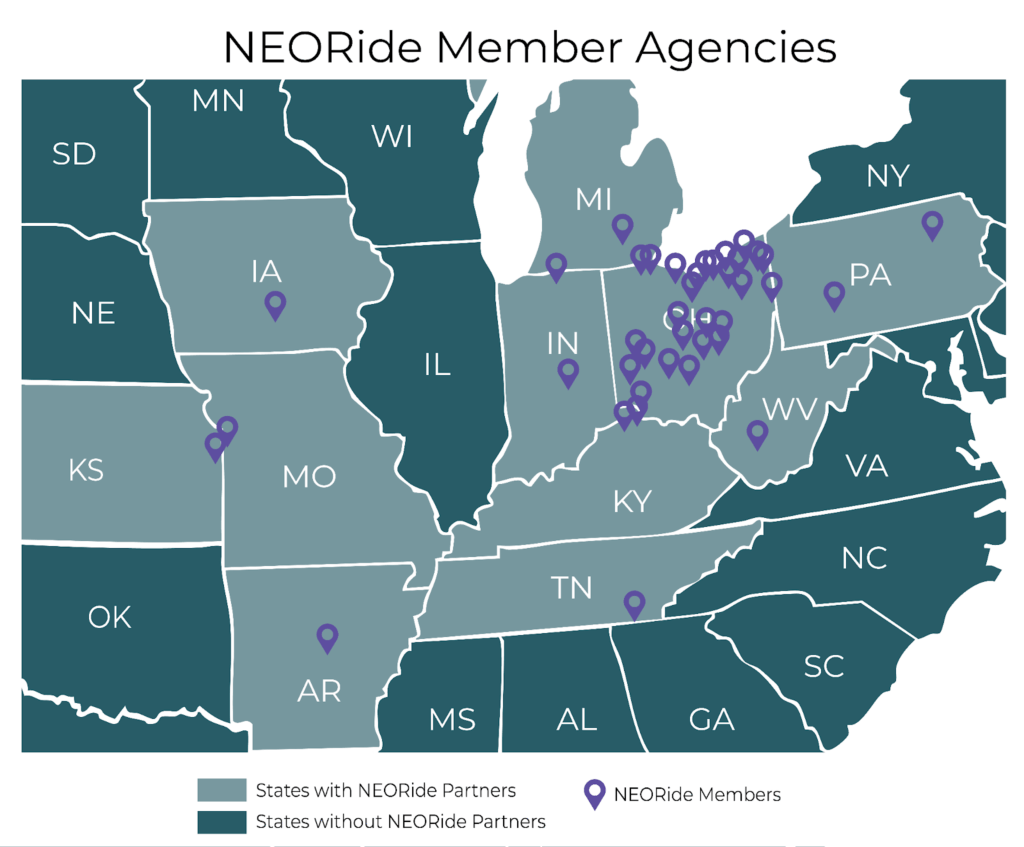
NEORide’s footprint of over 40 different agencies across 11 states, as of November 2025. Credit: SUMC
The EZfare Platform
One of NEORide’s core initiatives is EZfare, an account-based fare payment platform intended to make interagency and intercounty travel easier and more convenient for riders, and easier for agencies to administer. EZfare’s concept began in 2018, when some of NEORide’s member agencies recognized that many of the trips they served were single legs of longer journeys, with riders transferring to or from other transit services. These trips, which cross county lines and transit service boundaries, often required riders to purchase multiple fares from different agencies. Neighboring transit agencies had differing fare prices and fare payment options, had different fareboxes on board vehicles, and were governed by different fare policies. For travelers using multiple transit systems or making trips across county lines, the lack of fare integration made travel more complicated, more inconvenient, and more expensive. To address this, NEORide began exploring an account-based mobile ticketing solution that would simplify this process and ensure ease of mobility across jurisdictions.
In March 2020, the Stark Area Regional Transit Authority (SARTA), one of NEORide’s founding agencies, was awarded nearly $2 million through the FTA’s IMI program to lead NEORide in the development of EZfare. NEORide worked with fare technology company Masabi to develop the EZfare system, which included a mobile app, web platform, and onboard fare validators.
Through the EZfare mobile app or web-based portal, customers can create an account and load it with fare value, which is then deducted when they use a transit service. EZfare users can also add funds to their accounts at select transit centers or retail locations. When a rider purchases a ticket, that purchase is indicated by a validation screen on the app with a moving barcode. The rider can show the validation screen to the driver to confirm their fare was paid. Alternatively, some EZfare agencies have onboard validators that read and accept barcodes from a phone screen.
Video instructions on how to use EZfare for agencies that employ validator machines on buses. Credit: Laketran
With account-based ticketing payment systems, fares can be calculated and charged to a user’s linked account after the trip, rather than at the time of purchase. This can allow for more flexibility for riders on certain systems. For example, if a transit system uses fare capping, an account-based ticketing system can calculate an exact fare based on a rider’s travel pattern, and the rider will not have to determine the fare amount or type of ticket to purchase up front.
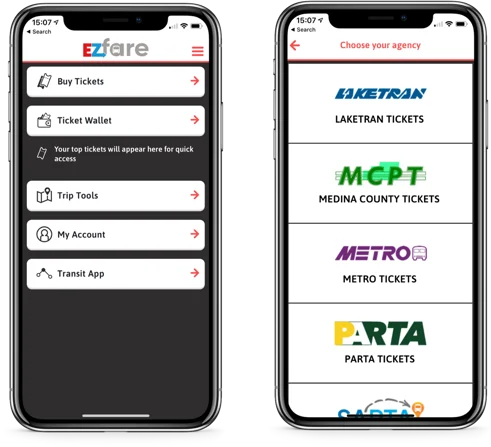
Screenshots of the EZfare mobile app. Credit: Masabi
While digital ticketing solutions can help simplify fare collection, improve the customer experience, and facilitate multi-jurisdictional trips, small- and medium-sized agencies often face significant barriers in obtaining this technology. Technology vendors tend to prioritize large contracts, as partnerships with large transit agencies usually fit better with these companies’ business models. While smaller agencies can similarly benefit from these technologies and partnerships, they are often left behind. As a collective, NEORide helps these small- and medium-sized agencies through joint procurement efforts. When agencies can band together as a collective, they can procure technology as a single large entity with increased buying power.
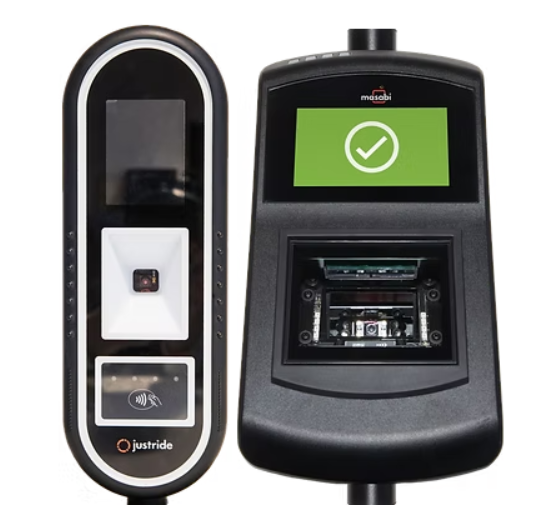
Two examples of EZfare validators installed on buses in the NEORide network. Credit: NEORide
This system allows for each participating transportation provider to retain independence in setting fare policy. Each agency can set its own fare price, rules, and method while also making the service seamless for users. But despite this independence, participating agencies still benefit from being a part of the NEORide collective through sharing resources, information, best practices, and marketing tools.
Because of these different fare policies and structures, fares are generally not transferable between transit agencies. However, some NEORide agencies, like TANK and SARTA, have coordinated to offer a single pass that works across multiple agencies. In other cases, EZfare still facilitates trips by allowing users to easily purchase multiple tickets in a single platform, and one of NEORide’s goals is to further foster interconnectivity by developing integrated tickets.
Expansion of EZfare
Cashless payment is becoming more universal for businesses in many industries, and general public familiarity with these systems continues to grow. This growing familiarity with digital and mobile payment options, coupled with extensive marketing efforts among participating agencies, has led to an increase in riders using EZfare since the conclusion of the IMI program. EZfare offers a practical way for riders to pay for transit trips, and NEORide’s pilot demonstrated how mobile ticketing technology like EZfare can make transit more convenient for riders and more efficient for transit agencies.
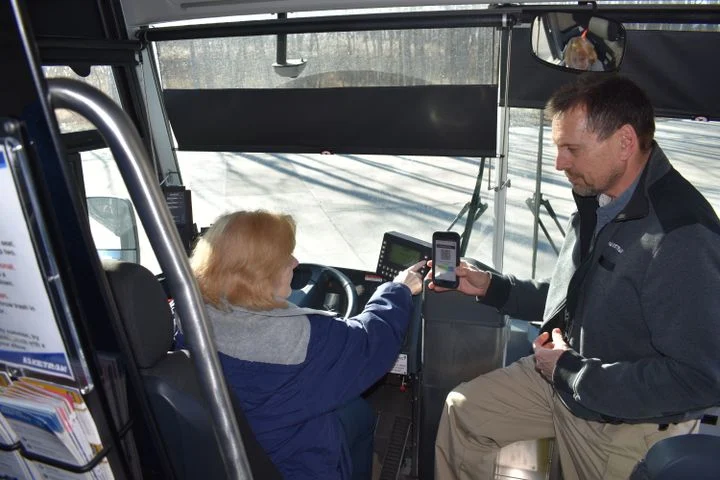
A passenger shows a bus driver payment validation using the EZfare mobile app. Credit: Laketran
EZfare’s expansion extends beyond an increase in users; since the end of the project’s pilot phase, transit agencies in multiple states have adopted the system. EZfare began with a handful of small agencies exploring innovative solutions for mobile ticketing across county lines, and has since grown into the largest multi-jurisdictional fare payment system in the United States. Currently 18 agencies throughout Ohio, Indiana, Michigan, Kentucky, Pennsylvania, and West Virginia have adopted EZfare:
- Laketran in Lake County, Ohio
- Medina County Public Transit (MCPT) in Medina County, Ohio
- METRO Regional Transit Authority (RTA) in Summit County, Ohio
- Portage Area Regional Transportation Authority (PARTA) in Portage County, Ohio
- Stark Area Regional Transit Authority (SARTA) in Stark County, Ohio
- Toledo Area Regional Transit Authority (TARTA) in Toledo, Ohio
- Lancaster Fairfield Public Transit in Fairfield County, Ohio
- Butler County Regional Transit Authority (BCRTA) in Butler County, Ohio
- Cincinnati Metro in Cincinnati, Ohio
- Sandusky Transit System (STS) in Erie County, Ohio
- Transit Authority of Northern Kentucky (TANK), in Boone, Campbell, and Kenton Counties in Kentucky
- The Ride in the Ann Arbor-Ypsilanti Area of Michigan
- Community Action Rural Transit System (CARTS) in Columbiana County, Ohio
- Kanawha Valley Regional Transit (KRT) in the area around Charleston, West Virginia
- Greater Cleveland Regional Transit Authority (GCRTA)
- Greene CATS in Greene County, Ohio
- Altoona Metro Transit (AMTRAN) in Altoona, Pennsylvania
- CityBus in Lafayette, Indiana
The Cincinnati Connector streetcar system was previously an EZfare agency, but left NEORide after fares were eliminated during the COVID-19 pandemic.
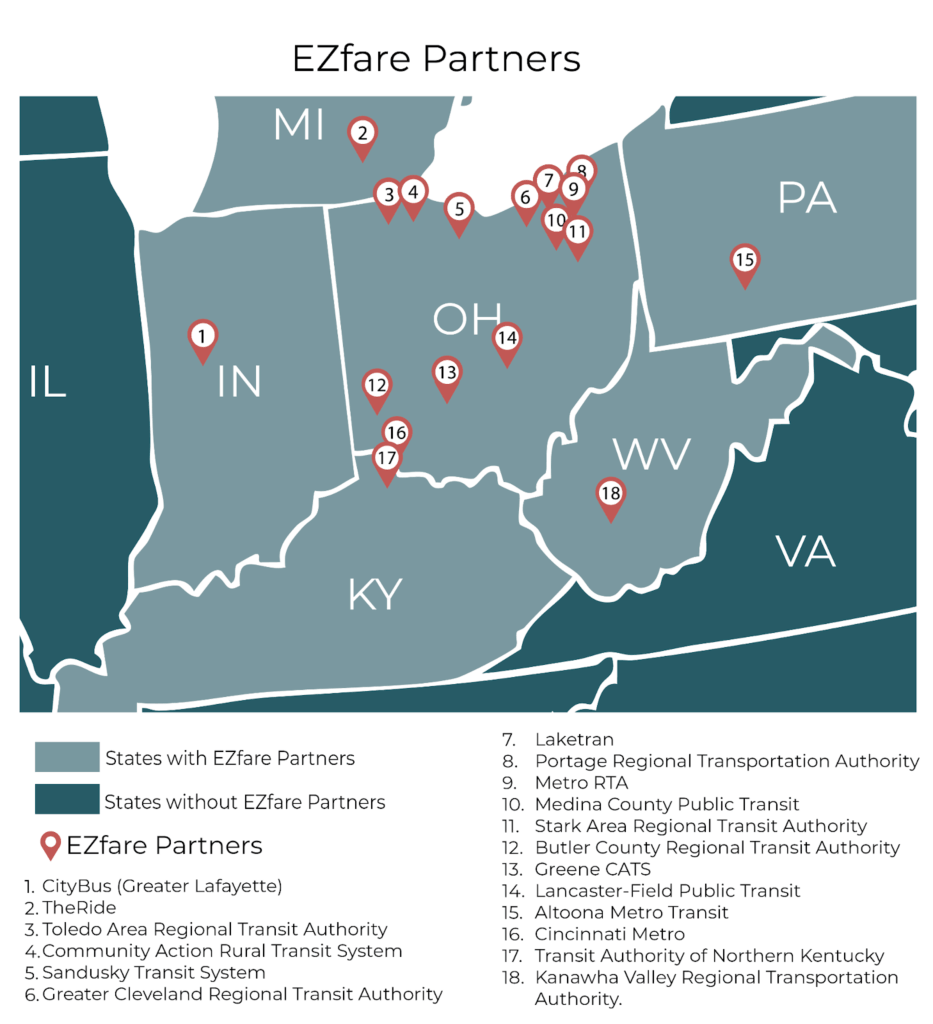
Locations of all EZfare partner agencies as of November 2025. Credit: SUMC
As EZfare’s footprint grows, NEORide is gaining a broader pool of funding sources to support and expand the system, including grants from the Federal Highway Administration and the Ohio Department of Transportation (ODOT). Notably, NEORide was awarded $3.3 million in 2019 from ODOT’s Ohio Transit Partnership Program (OTP2) to install validators on fixed-route buses using EZfare.
Transit agencies maintain substantial autonomy in how they implement EZfare; some agencies still do visual validation aboard buses, while others have added validators, contactless payment systems, or employ account-based ticketing. Several participating agencies, including SORTA, TANK, BCRTA, Laketran, KRT, AMTRAN, CityBus, Metro RTA, and PARTA have also used the EZfare platform to implement fare capping, further enhancing the affordability and accessibility of transit.
EZConnect
After the establishment of EZfare, NEORide developed EZConnect with support from a $1.5 million Advanced Transportation and Congestion Management Technologies Deployment (ATCMTD) from the Federal Highway Administration, a $1.25 million Senate Appropriations Request, and additional funding through ODOT.
EZConnect, which fully launched in 2025, is a centralized one-click/one-call program that serves multiple agencies in different geographies by pairing riders with on-demand transportation services. In large regions with multiple transit services, agencies often face challenges both with fulfilling complete multi-jurisdictional trips and with customer service, and EZConnect aims to address these challenges. EZConnect uses centralized dispatch and customer service centers that allow human services transportation users in multiple counties to easily make reservations and schedule rides. These call and dispatching centers work across agencies to facilitate interagency coordination and simplify trip planning. With EZConnect, if a rider calls the customer service line for Cincinnati Metro, that call will be rerouted to an EZConnect call center, which can then provide assistance or information about paratransit trips, scheduled service, or the EZfare system. There are currently six EZConnect partners: Trumbull County Transit, CARTS, WRTA, BCRTA, TANK, and Cincinnati Metro.
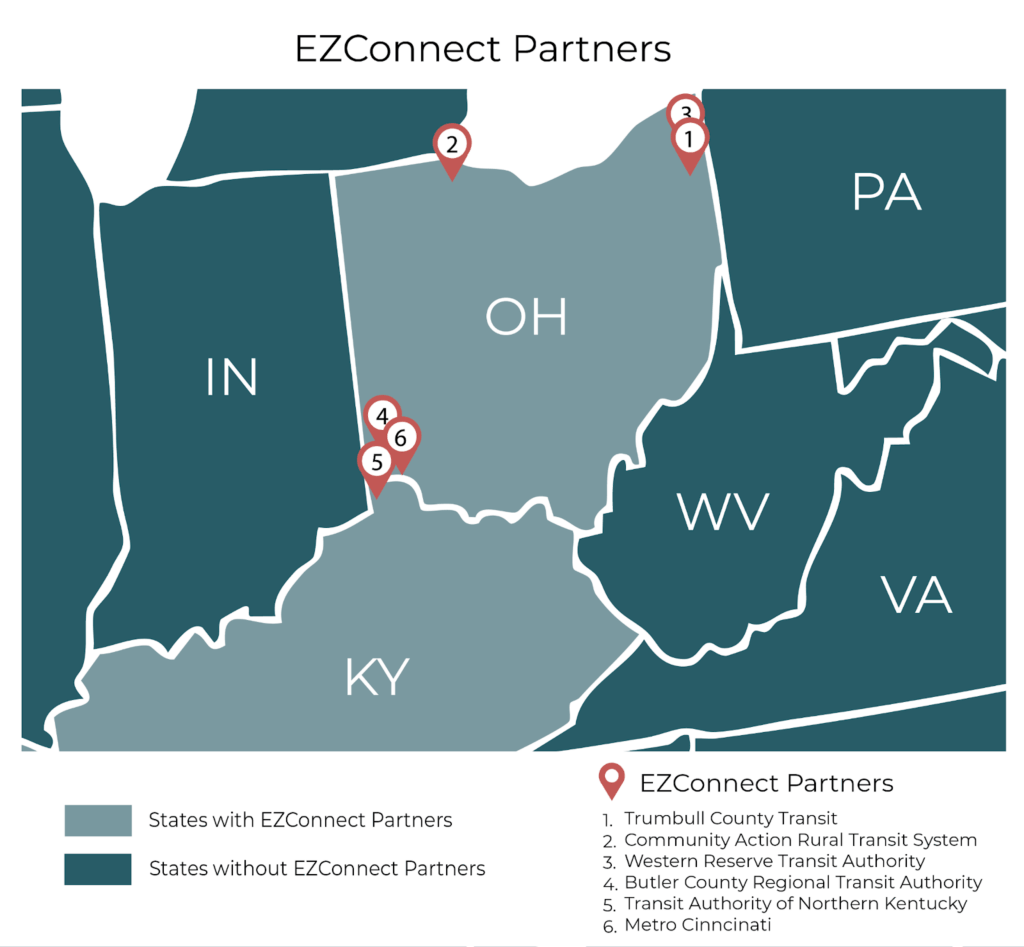
Locations of all EZConnect partner agencies. Credit: SUMC
Another aspect of EZConnect is the One Seat Ride pilot project, an innovative service designed to enhance paratransit interconnectivity and test the feasibility of regional shared paratransit. Through One Seat Ride, paratransit customers can schedule single trips that previously would have involved multiple legs and transfers. This has allowed riders to travel across multiple counties without having to book through separate services. Riders also no longer have to transfer between services, which NEORide recognized as an issue, particularly for paratransit users with physical disabilities. One Seat Ride customers can also use the EZfare platform to purchase passes for the service.
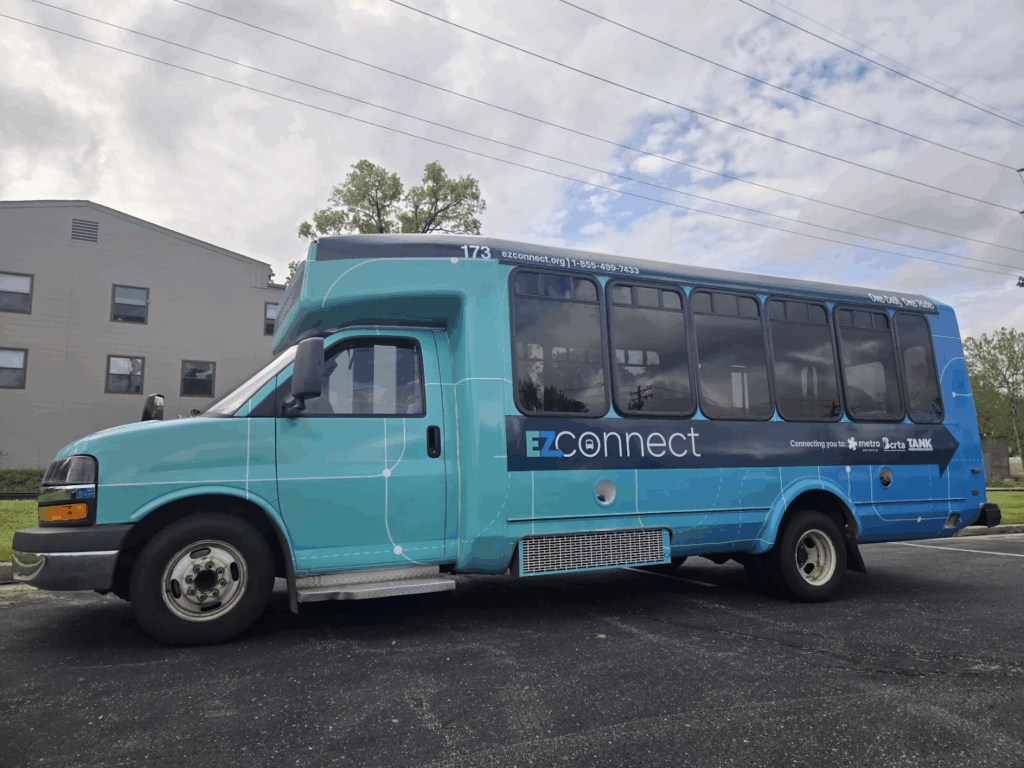
An EZConnect paratransit bus. Credit: WVXU
It can be difficult for small agencies to access the same resources as large agencies. EZConnect helps participating agencies coordinate and leverage resources for more efficient and more seamless human services transportation. As transportation providers continue to recognize the complex and changing needs of riders, programs like EZConnect help them embrace new processes and technologies for a people-centric approach to service provision. EZConnect exemplifies how agencies can coordinate and leverage resources to deliver comprehensive mobility management services.
Impacts and Lessons Learned
NEORide has been able to sustain EZfare past the IMI grant pilot phase, improve on the technology, and greatly expand its adoption. In the process, NEORide gained valuable insights about managing and piloting an unprecedented regional fare integration project and transitioning that project from pilot to permanent.
Behind the technology and fare integration aspects, EZfare requires a significant amount of coordination, communication, and collaboration between its members. Participating agencies need both a willingness to collaborate and to be able to see the value in the bigger picture of how the project could improve regional transportation. To foster this environment, NEORide needed to allow each agency the appropriate autonomy and flexibility to make decisions about their own systems, while still encouraging them to work together as a group. Each agency is unique, with its own set of needs and challenges, and each agency knows how best to serve its community. Even though EZfare is a joint effort, NEORide’s commitment to agency independence allows each provider options on how best to serve their riders.
Finding the balance between agency flexibility and group cohesion has at times presented challenges for NEORide. As mentioned previously, partner agencies are unique and focused on different community needs. Getting partners to agree on new policies or ideas is not always straightforward.
Strong communication is critical to advancing any project of this scale, which can be a significant barrier, particularly for a multi-agency, multi-jurisdictional, and multi-state project like EZfare. However, an influx of online communication tools and participants’ familiarity with these tools in the wake of the COVID-19 pandemic, in addition to state policies encouraging virtual communication, provided NEORide an opportunity to facilitate coordination between members. NEORide is expansive, covering multiple states, and regular virtual meetings allow members to easily interact and ensure that partners can stay on the same page. For NEORide, it was important to simplify this participation as much as possible. Overly complex rules and procedures could deter participation in the project, and ultimately hurt the outcome.
Throughout the IMI program, NEORide participated in peer knowledge-sharing with other grantees from the FTA’s IMI and Accelerating Innovative Mobility (AIM) programs. These forums, convened by the Shared-Use Mobility Center through the Mobility Innovation Collaborative, allowed NEORide to exchange ideas, share strategies, and discuss challenges with transit agencies, state departments of transportation, and other organizations working on innovative mobility projects throughout the country. The relationships built through these workgroups proved valuable after the IMI program; NEORide continues to communicate with other IMI and AIM program participants, and continues to use lessons learned to help refine and improve upon EZfare.
In addition to supporting the procurement of validators and software for EZfare, the IMI grant also funded a research project through Cleveland State University to examine the impacts of EZfare on the travel behavior of low-income, underbanked, and unbanked transit riders. The research surveyed over 1,600 transit riders and explored how EZfare helped agencies in Ohio and Kentucky predict responses to service adjustments in light of large-scale and extended events like the COVID-19 pandemic. The study discusses how banking status influences travel behaviors, and how service cuts like those during the pandemic negatively impact unbanked, underbanked, and low-income riders, who disproportionately rely on public transportation. Because of this, researchers also point out that the adoption of mobile fare payment technology and payment platforms like EZfare is essential in making transit accessible for all users. EZfare enables unbanked and underbanked users to load cash into their accounts at select retail locations or transit facilities, addressing a major concern for these populations as many agencies across the country prioritize cashless fare policies.
Additional Initiatives
NEORide continues to improve EZfare and has plans to support further payment integration between agencies. Currently, EZfare provides the ability to purchase multiple tickets through a single platform. Some EZfare agencies, including TANK and Cincinnati Metro, have coordinated to offer a single pass that works across multiple different agencies and modes. One of NEORide’s goals for the future of EZfare is to further facilitate interagency integration and roll out integrated tickets to help riders travel across systems.
Outside of EZfare, NEORide is moving forward with various initiatives to improve transportation across its partner services. One of these initiatives is a workforce development program. In 2023, NEORide worked with the Ohio Department of Transportation, and CALSTART on a coordinated proposal for FTA’s Low or No Emission Grant Program. While these awards require a 5% set aside for workforce development, NEORide and its partners wanted to build a single permanent program that could expand with other partner agencies in the future. NEORide, in collaboration with CALSTART and ZEB Tech, launched Phase 1 of the workforce development project in early 2025, with a focus on career development and training to work in coordination with 10 rural and large urban transit agencies around Ohio. The program centers on career development and training for jobs specifically related to the maintenance and operation of low-emission vehicles.
NEORide is also managing a project to provide new safety systems and enhance existing safety systems to agencies around Ohio through a US Department of Transportation Strengthening Mobility and Revolutionizing Transportation (SMART) grant. The project will pilot these advanced vehicle safety technologies on three Ohio systems to test and evaluate how they can reduce the number and severity of crashes.
Conclusion
With EZfare, NEORide piloted an innovative single payment system that operates across counties, jurisdictions, modes, and mobility providers. Digital platforms like EZfare simplify ticketing for riders and facilitate transfers between systems by letting riders plan and purchase fares for a complete trip in one convenient place. EZfare is now the largest multi-agency fare payment system in the country, and as it grows, it will pave the way for more integrated and coordinated transportation.
More broadly, NEORide is an industry leader in promoting coordination between transit agencies. Transit agencies—particularly small ones—are often siloed from each other, with limited communication and cooperation. NEORide works through these silos and allows partner agencies to share and leverage resources, knowledge, and market power, ultimately uplifting all partners and improving mobility services throughout its multi-state footprint. NEORide’s initiatives, including EZfare, EZConnect, and its other innovative projects make it a leading force in mobility integration.