AVs + Rideshare = RAPID, Arlington, TX
20 minutes Date Launched/Enacted: Jan 16, 2026 Date Published: January 16, 2026
Brief Summary
- In early 2021, the City of Arlington expanded a public mobility-on-demand (MOD) program city-wide.
- Arlington previously completed two other autonomous vehicle (AV) pilot projects with separate partners, EasyMile and Drive.ai.
- Arlington integrated a new AV pilot into its MOD network after successfully applying for an Integrated Mobility Innovation grant from the Federal Transit Administration.
Description: Video interview with Ann Foss from the City of Arlington.
Credit: Shared-Use Mobility Center (SUMC)
Note: SUMC’s Mobility Learning Center hosted a public forum with Ann Foss on January 12, 2022. Click here to watch a recording of this event.
This pilot project is part of the Mobility Innovation Collaborative (MIC) program. The MIC program provides a comprehensive suite of technical assistance resources, promotes knowledge sharing activities, and captures stories and lessons learned from nearly 50 innovative mobility projects across the United States.
Originally published in November 2021, and revised in January 2026.
Introduction
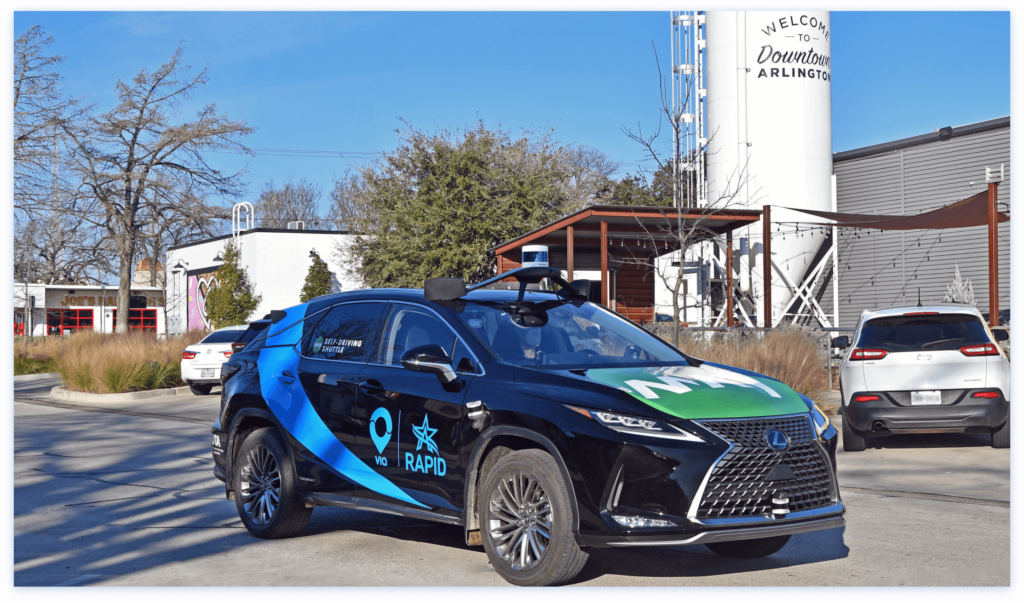
What do you get when you mix autonomous vehicles (AV) with mobility on-demand (MOD)? RAPID! After piloting two other AV projects and expanding a rideshare program, the City of Arlington developed RAPID, also known as the Rideshare, Automation, and Payment Integration Demonstration, in Spring 2021. This AV program is a first-/last-mile mobility option for people inside a 1 square mile area that includes Arlington’s downtown core and the campus at the University of Texas at Arlington (UTA). Using an app, Via, customers can request low-cost or fare-free shared AV rides as part of the city’s broader MOD network.

Description: Map of RAPID’s 1 square mile service area.
Click on image for full view.
Credit: City of Arlington
After securing a Federal Transit Administration Integrated Mobility Innovation grant and seeing the successes of its other mobility initiatives, City of Arlington staff leveraged their relationships with new and existing partners to design a program well-tailored to their needs as a city in the Dallas-Fort Worth metropolitan area. This case study explores how RAPID developed and how it serves people in Arlington.
History of the Program
Arlington prides itself for being the first city in the United States to offer AVs for public use, testing different solutions since 2017. Milo, the city’s first AV pilot, ran from August 2017 to August 2018 when it partnered with EasyMile to provide off-street shuttles to and from parking areas and venues in the city’s Entertainment District. In October 2018, Arlington transitioned into its second AV pilot in partnership with Drive.ai. This pilot also took place in the Entertainment District but on the street network, where passengers could use on-demand autonomous vans to get to and from different employment sites and venues. The Drive.ai pilot ended in May 2019.
Coinciding with these AV pilots, Arlington also implemented a mobility on-demand pilot that replaced its one bus transit route. In partnership with Via, passengers can request point-to-point shared rides within the City. When the Arlington Via Rideshare program first began in 2017, it offered customers access to 16 Via vans within a service area of 26 square miles. In 2020, Arlington Via Rideshare expanded its fleet to 28 vehicles and its service area to 40 square miles. At the beginning of 2021, Arlington Via Rideshare further widened its service area to all of Arlington, an area of 99 square miles, with a fleet of 70 vehicles. Via provides the vehicles for Arlington’s rideshare service through an agreement with Avis, a car rental company.
At the same time, Arlington was planning to integrate its third AV pilot, the Rideshare, Automation, and Payment Integration Demonstration (RAPID), into the rideshare network.
The City of Arlington worked with Via and May Mobility, an AV company that emphasizes deploying safety-first technologies, to apply for outside funding for the RAPID project idea. In early 2020, the City of Arlington received an Integrated Mobility Innovation grant from the Federal Transit Administration. With federal dollars secured, City staff, along with project partners at Via, May Mobility, and the University of Texas at Arlington, worked to develop the RAPID program for its launch in March 2021.

Description: The City of Arlington launched RAPID in 2021 after running different AV and microtransit pilots since 2017.
Click on image for full view.
Credit: Via
Program Operations
Arlington RAPID launched on March 23, 2021 for a one-year pilot. RAPID’s operating zone is a 1 square mile area that includes the city’s downtown core and the campus at the University of Texas at Arlington. May Mobility provides a fleet of five vehicles: four hybrid electric Lexus RX 450h’s and one electric wheelchair accessible Polaris GEM.
RAPID is integrated into the citywide Via Rideshare microtransit program with the same fare rates and a limited amount of free rides available to UTA students.
Standard fares for using Arlington Via Rideshare are:
- Trips from 0-1.5 miles: $3.00
- Trips from 1.5-3 miles: $3.50
- Trips from 3-4.5 miles: $4.00
- Trips from 4.5-6 miles: $4.50
- Trips over 6 miles: $5.00
Since rides on RAPID tend to be short distances within a small service area, a standard fare usually amounts to $3 and can be paid through the Via app by credit, debit, or prepaid card. As of now, rides are fare-free for students at the University of Texas at Arlington, supported through Arlington’s $1.7 million grant from the Federal Transit Administration.
Customers can request shared rides through Via’s app or by phone between 7 AM and 7 PM, Monday through Friday. If their origin and destination are within the zone for RAPID, they are given the option to select a RAPID or standard Via Rideshare vehicle. An attendant staffs every ride on RAPID and can manually operate the vehicle when necessary.
During much of the COVID-19 pandemic, rides were limited to only one booking of up to two passengers riding together. That restriction was lifted during the summer of 2021 as the city began to re-open and more people received vaccinations. Up until mid-summer, partitions were also placed in between passengers and the vehicle attendant. Passengers and the vehicle attendant are required to wear masks for the duration of the pandemic. The vehicles are also cleaned on the inside daily so as to mitigate the risk of virus transmission.
Program Goals and Outcomes
RAPID ridership has steadily increased since beginning operations on March 23, 2021. As of November 2021, RAPID has provided over 15,000 rides to members of the Arlington community. Up until August 2021, 96.5% of RAPID passengers are students at the University of Texas at Arlington.
Customers who have the choice to use RAPID autonomous vehicles or Arlington Via Rideshare standard vans, based on their origin and destination, have increasingly opted to use the RAPID service. At first, only about half of these eligible riders in the 1-square-mile RAPID zone selected the AVs. As of August 2021, between 60 and 70% of these eligible customers chose to ride a RAPID vehicle.
RAPID has also been popular with customers, who rated the quality of their experience at an average of 4.9/5, with 5 being the highest rate of satisfaction. As of August 2021, wait times have stayed an average of under 12 minutes and rides have arrived on time more than 90% of the time. At the end of August, about 67% of rides on RAPID were shared between different passenger parties. As a result of high levels of construction in downtown Arlington, there are significant periods of time in which the vehicle attendant is required to operate the vehicle manually; May Mobility has determined that its RAPID vehicles have been able to operate autonomously about 75% of the time.
Budget and Planning
The City of Arlington supports the RAPID program with an approximate $2.8 million budget. In 2019, the City applied for and earned an Integrated Mobility Innovation grant of $1,698,558 from the Federal Transit Administration. The remaining $1,146,925 is supported through in-kind contributions from May Mobility, Via, UTA, the city, and dollars from the municipal budget.
Marketing
The City of Arlington, Via, May Mobility, and the University of Texas at Arlington utilized a variety of traditional methods to market the RAPID and citywide ridesharing program. When the Arlington Via Rideshare service first launched, staff carried out targeted outreach to community groups, senior centers, and UTA students. As the program expanded, the City of Arlington also marketed the ridesharing service through billboards and radio announcements.
Description: Video promotion for RAPID.
Credit: City of Arlington
As Arlington Via Rideshare evolved into offering RAPID at UTA’s campus and in the city’s downtown core, the City of Arlington and its partners marketed the program through social media, local news outlets, and presentations to community groups. At UTA, there were ads and promotions in the student newspaper, flyers across campus, and rider outreach at student orientation events. A research group also conducted three focus groups to measure interest in RAPID. These focus groups respectively included the general public, people at UTA, and people with disabilities. From these focus groups, the City of Arlington realized that there was little interest in RAPID from people with disabilities.

Description: UTA’s student newspaper has an ad for Arlington RAPID on its homepage.
Click on image for full view.
Credit: The Shorthorn
Accessibility
One of the five vehicles in RAPID’s fleet, a Polaris GEM, is specifically designed to serve people with disabilities. The vehicle can hold one passenger on a wheelchair at a given time. Like the Lexus AVs, the Polaris GEM also has an attendant when in operation who can manually operate the vehicle as necessary and assist the passenger.
Members can request wheelchair accessible rides on the Via app by indicating their accessibility needs in their account profile. The Via app also supports voice-to-text features for people with vision impairments. Customers can also choose to request rides for RAPID or Arlington Via Rideshare by calling a local phone number and talking with a Via call center.
The City of Arlington marketed the Polaris GEM to the broader community of people with disabilities by inviting players from the University of Texas at Arlington Lady Movin’ Mavs wheelchair basketball team to ride on the vehicle and offer feedback. At this time, there have been no organic completed rides from community members on the Polaris GEM. In a survey, staff at the City of Arlington realized that only a small proportion of customers indicated a need for wheelchair accessible vehicles.
Description: Video promotion for RAPID’s wheelchair accesssible Polaris GEM vehicle with members of UTA’s Lady Movin’ Mavs wheelchair basketball team.
Credit: City of Arlington
Challenges and Lessons Learned
Both the RAPID pilot and Arlington’s partnership with May Mobility, Via, and UTA continue to run smoothly. Nonetheless, certain challenges have been observed with RAPID being a first-of-its-kind pilot in the AV space.
- Integration: Via and May Mobility had partnerships that pre-existed their pilot with Arlington, but had some new challenges in integrating their platforms for RAPID. In other programs, May Mobility has commonly used the Polaris GEM. Integrating their application programming interfaces (APIs) into the Lexus vehicles and Via’s routing software took longer than expected.
- High temperatures and noise on vehicles: RAPID customers complained that the Lexus vehicles became hot and that the computing stack for the AV technology, located in the back trunk, was loud. Program staff suspected that the levels of heat were created by a mixture of high outdoor temperatures, poor air circulation due to the partitions separating the driver from the passengers, and from the computing stack. When COVID-19 restrictions began to loosen up during the summer, RAPID program staff removed the partitions, increasing air flow and making the vehicles more comfortable. Engineers from May Mobility also designed a box that covers the computing stack fan output, muting some of its noise and channeling its hot air out through the back of the vehicle.
- AV operations: Some elements in the environment outside of AVs have affected their ability to operate at complete autonomy. High levels of construction in the downtown core of the RAPID zone have required that vehicle attendants manually operate the vehicles at times. Overgrown bushes alongside the RAPID routes and sunglare generated from stoplights have also created challenges for the LiDAR sensors on the vehicles. Engineers at May Mobility have accounted for these difficulties and are looking to improve the processing of data for their vehicles. Due to these minor challenges, the RAPID vehicles have operated at full autonomy about 75% of the time.
Conclusion
In its first year of operation, RAPID can be considered a highly successful pilot. After launching in the midst of a pandemic, ridership steadily increased and popularity for RAPID remained high. RAPID did encounter obstacles with integration of different partner technologies, noise and heat inside vehicles, and autonomous operations. Fortunately, the City of Arlington has been able to navigate these challenges based on its strong partnerships with Via, May Mobility, and UTA.
AVs are an experimental mode of transportation in the shared mobility space. As a result, best practices are yet to be well established in how they should be used in communities. Since Arlington has hosted different iterations of AV projects, the City entered the pilot with a relatively strong understanding of how they could leverage this partnership with their technology projects. After securing funding from the Federal Transit Administration, Arlington staff was clear with its expectations to Via and May Mobility on subjects like data sharing, safety, vehicle contracting, integration, and deployment. Arlington built on its experiences of earlier AV pilots and its partnership with Via to provide a new version of its on-demand microtransit service. Having this institutional knowledge, along with a clear scope and vision, helped to make this pilot project a success. Transit agencies and municipalities should consider factors like these as AV pilots become more commonplace across the United States.
Key Considerations for Developing an AV Program:
- What community need(s) can your AV program address? Consider using a needs assessment to determine how and if an AV program should serve your community.
- Know what AVs best serve your community. How many passengers can be on a vehicle at a given time? Are the vehicles best designed to navigate an on-road or closed environment?
- Be clear about the deployment environment. Are the AVs for a fixed-route or mobility on-demand service? Does the service function as a shuttle and/or a first-/last-mile operation? Are the AVs meant to serve a dense commercial area, a business district, a school/university, a recreation district, or a residential area?
- Is your AV program a completely new service or does it supplement an existing service? How can you integrate the AV program into what existing service you have? Will it serve your community more effectively than these other services?
- Speak upfront with potential partners. What can different companies in the AV industry provide you? What needs exist across different communities in your service area? Can you receive financial and in-kind support from technology companies, foundations, and other government agencies?
- Identify opportunities to form and strengthen partnerships across other government agencies. What are your project needs and what can other agencies bring to the table?
- Ask yourself how you want to oversee your AV program. Do you want to manage the day-to-day operation? Or, do you want a turnkey solution?
- Be clear about your data needs with your AV and technology vendor(s) and understand your internal limitations to process large datasets.
Watch an interview with Ann Foss who oversaw RAPID’s implementation.
Published on November 16, 2021, Revised March 2025
2025 Update

A RAPID vehicle. Credit: City of Arlington
Although RAPID was initially planned to operate as a one-year demonstration funded by an Federal Transit Administration (FTA) Integrated Mobility Innovation (IMI) award, in 2022 the City of Arlington was able to extend the project with $4.5 million in funding support from the North Central Texas Council of Governments (NCTCOG) through its Automated Vehicle Program, an initiative aimed to test AV capabilities in various deployments across the region. This extension accompanied some operational changes, including a reduction in operating hours (previously 7:00am to 7:00pm, Monday through Friday, and reduced to 12:00pm to 6:00pm, Monday through Friday), and a shift to a $1 fare discount for UTA students rather than the previous zero fare policy.
After its first year demonstration period, Arlington transitioned the RAPID fleet from its initial five vehicles (four Lexus and one Polaris GEM) to four Toyota Sienna minivans, one of which was wheelchair accessible. These minivans carry up to 5 passengers, allowing Arlington to increase passenger capacity and sharing capacity for the remainder of the service.
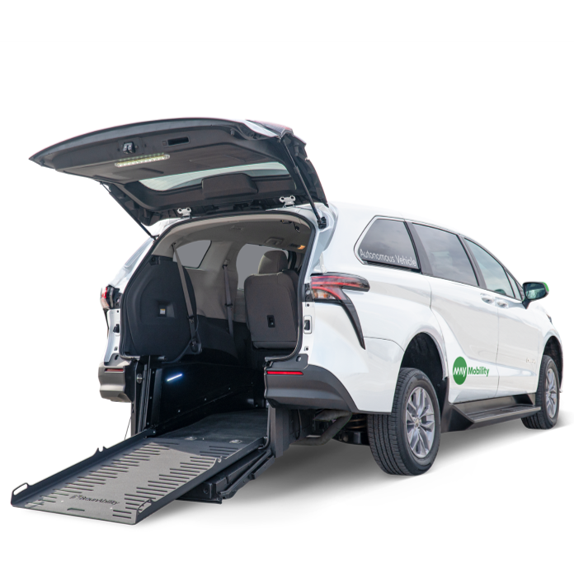
RAPID’s wheelchair accessible Toyota Sienna. Credit: City of Arlington
While Arlington explored potential funding models to continue the program beyond the funding support from the FTA IMI award and the NCTCG’s Automated Vehicle Program, the City ultimately concluded that the service was financially unsustainable through the traditional funding streams of FTA Urbanized Area Formula funds, Arlington’s General Fund, and fares. The City of Arlington’s transit operating funds in 2024 were roughly $13.9 million, with about 40% of that money coming from the City’s General Fund. Furthermore, RAPID’s one square mile service area covers only a small portion of Arlington’s 99 total square miles, which is served by Arlington’s fleet of just over 100 vehicles total. Without additional outside funding sources, it was difficult to justify continuing RAPID.
Ultimately, after a 4-year demonstration period, RAPID ended operations in May 2025, coinciding with the end of the UTA school year. As the program wrapped up, Arlington reminded the public in its marketing and engagement materials that the service was intended to serve as a demonstration project without a guarantee that it will become permanent, and RAPID users could still access Arlington’s human-operated on-demand rideshare service as needed.
As a key project partner, the University of Texas at Arlington, led by professors in the Civil Engineering Department and the Executive Director of Auxiliary Services, performed research throughout the project to study and share impacts from the RAPID demonstration. The UTA research team analyzed trip and ridership data, conducted interviews and focus groups, and developed and administered surveys both to RAPID riders and the general public to collect feedback on the service and on AV technology in general.
Feedback from these surveys was consistently positive. Responses revealed that RAPID users felt overwhelmingly safe and comfortable in the vehicles. Additional user data showed a large number of repeat riders, suggesting that the service fit into many peoples’ daily transportation routines. Survey responses from about 300 riders revealed that riders used the service for a variety of purposes, with “Going to school” being the most common answer (34%), and that nearly half (47%) of riders did not have access to a personal vehicle. The surveys also revealed that the majority of RAPID riders (79%) were UTA students, and a total of 98.5% of all RAPID rides were taken by UTA students.
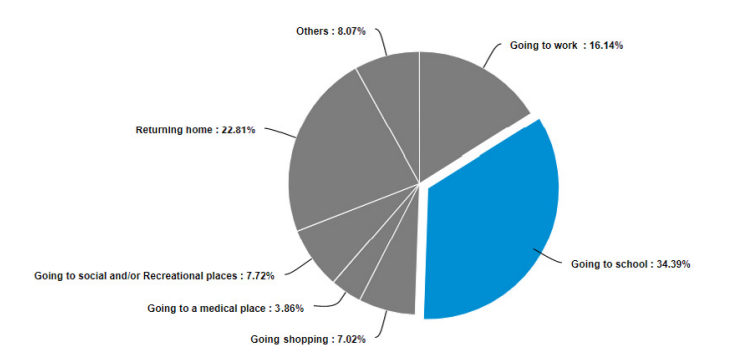
Survey responses illustrating common RAPID trip purposes. Credit: FTA
The City of Arlington collaborated with UTA researchers in publishing several research papers about AV technology based on the RAPID’s case. In addition, the UTA team is expanding its research on key topics surrounding AV technology, including studying how best to get AVs to fully function without a human operator present and the legal and safety implications of driverless vehicles interacting with first responders.
RAPID’s AV technology improved significantly over the course of the pilot period, and by the end of the project in May 2025, RAPID was operating at nearly 100% autonomy in the majority of the service area (in other words, vehicles were driving almost completely independently along most streets, with virtually no human input). However, at some locations, certain street features like high pedestrian activity, at-grade railroad crossings, or unprotected left turns posed navigation challenges for RAPID’s AV technology even at the end of the pilot period, and human operators sometimes intervened. Additionally, periodic road construction caused vehicles to reroute to streets that Arlington did not initially plan to have the vehicle navigate, which also may have occasionally caused challenges.

Maps showing RAPID’s autonomy performance at the beginning and end of its pilot period. Credit: City of Arlington.
From its first AV pilot, Milo, in 2017, to its second on-street pilot with Drive.ai, and finally with RAPID, the City of Arlington has been a trailblazer in automation technology. By the end of the program, the City of Arlington and UTA had earned various awards for RAPID, including the Tech-InnovaCity Seoul Smart City Prize, a Transportation Planning award from the Texas Chapter of the American Planning Association, and the Texas Parking and Transportation Association’s Excellence Award.
Post-RAPID, Arlington does not currently have plans for a future AV service, but the City is still interested in exploring how AV technology can help fill transportation gaps and further mobility innovation. As AV technologies improve and technology costs decrease, reincorporating AVs into Arlington’s transportation network may become a future goal.
At the end of the IMI demonstration, RAPID had about 3,000 riders per month, compared to the roughly 50,000 total monthly on-demand rideshare passengers. Once the service ended in May 2025, RAPID had provided over 113,000 total rides to the people of Arlington.